
Some people are reading this after a long shift, with the washing still to do, wondering if teaching is a dream they should have let go of years ago. Maybe you left school without the grades you needed. Maybe university never felt possible. Maybe you've spent years putting everyone else first.
That doesn't mean your chance has gone.
If you want to help others learn, build a stable career, and show your children what persistence looks like, there is still a way forward. The path may not be the same as the one taken by someone who went straight from school to university, but that doesn't make your journey less real or less valuable. In many ways, it makes you better prepared for the heart of teaching: patience, empathy, resilience, and the ability to keep going when life is hard.
Your Dream of Teaching Is Closer Than You Think
Sarah is the sort of person schools need. She isn't famous, and she doesn't have a perfect CV. She has life experience. She knows how to calm people down, explain things clearly, and keep showing up when others feel like giving up.
For years, she thought teaching was closed to her because she didn't have a degree. She watched other people move ahead and told herself she had missed her moment. What changed was not magic. She learned that there are ways to start small, build experience, and work towards the right qualification step by step.

That might sound like your story too. You may already teach in everyday life without calling it teaching. You help a child with reading. You show a new colleague how to use a system. You coach someone through a problem without making them feel small. Those things matter.
Why this dream matters so much
Teaching isn't only about standing at the front of a room. It's about helping people believe they can do something they once thought was beyond them. Adult learners often make brilliant teachers because they remember what it feels like to doubt themselves.
A teaching career can also mean something personal. It can mean earning better, building a future with more security, and proving to yourself that your education story isn't over.
You don't need a perfect past to build a strong future in education.
Your children are watching
If you have children, they notice more than you think. They see whether you give up on yourself or keep trying. When they watch you return to learning, improve your English or maths, and work towards a professional goal, they learn that setbacks don't define a person.
That example can last a lifetime.
Many adults start this journey feeling embarrassed about old grades or missed chances. Then something shifts. One course leads to another. Confidence grows. A job becomes a career. A parent becomes the person their child proudly talks about at school.
If you've been searching for how to become a teacher without a degree, the most important thing to know is this: you are not starting from nothing. You're starting with experience, determination, and a reason that runs deep.
First Steps Into the Classroom Without Qualifications
You don't have to wait until you're fully qualified to start building classroom experience. In fact, beginning with a support role is often the smartest move. It lets you test whether school or college life suits you, earn money, and grow your confidence before committing to formal training.
Roles that help you get started
A Teaching Assistant role is one of the most common starting points. You support pupils, help the teacher prepare resources, and work with individuals or small groups. Through this experience, many adults discover that they are far more capable than they thought.
A Cover Supervisor usually manages a class when the teacher is absent. You won't plan the full curriculum, but you will learn behaviour management, communication, and how schools run day to day.
Private tutoring is another option. If you're strong in one subject or good at helping children build confidence, tutoring can help you practise explaining ideas clearly.
If you're drawn to pastoral support, SEND support, or helping pupils one to one, a pupil support assistant course can help you understand the kind of role that gets you close to the classroom while you build experience.
What you learn before you qualify
These early roles teach skills that matter later:
- Classroom confidence: You get used to speaking clearly, giving instructions, and staying calm under pressure.
- Behaviour awareness: You learn what helps pupils settle, focus, and feel safe.
- Professional habits: You start working with staff, following school routines, and understanding safeguarding expectations.
- Real motivation: You find out whether teaching feels right in practice, not just in theory.
That last point matters. A lot of people love the idea of teaching. Fewer people enjoy the daily rhythm of it. Starting in a support role helps you find out, without taking a huge risk.
The unqualified teacher route needs caution
Some academies do hire unqualified teachers. That can sound like a shortcut, especially if you're eager to move forward quickly. But there is an important warning.
According to this Department for Education update discussed in a YouTube briefing, academies can hire unqualified teachers, but these staff are capped at 4 years of employment before they must achieve Qualified Teacher Status (QTS) to stay in the role. That creates a real cliff-edge if someone starts teaching without a long-term plan.
Practical rule: If you take an unqualified teacher role, treat it as a temporary stage, not a permanent answer.
This route can still be useful. It gives you paid experience and helps you confirm that you want to teach. But you need a qualification plan from day one. Otherwise, those years can pass quickly.
A simple way to choose your starting point
If you're unsure where to begin, use this guide:
| Your situation | Good first step |
|---|---|
| You want gentle entry and support | Teaching Assistant |
| You can manage groups and stay calm | Cover Supervisor |
| You know a subject well | Private Tutor |
| You want full classroom responsibility quickly | Unqualified teacher role, with a clear qualification plan |
You don't need to prove everything at once. Start where you can stand steadily. Confidence grows faster when the first step is realistic.
The Two Main Pathways to a Teaching Qualification
After your first classroom experience, the path can start to look foggy. You know you want to teach, but the titles, acronyms, and entry rules can make it feel like everyone else got a map and you did not.
You are not behind. You are choosing between two routes that were built for different starting points.
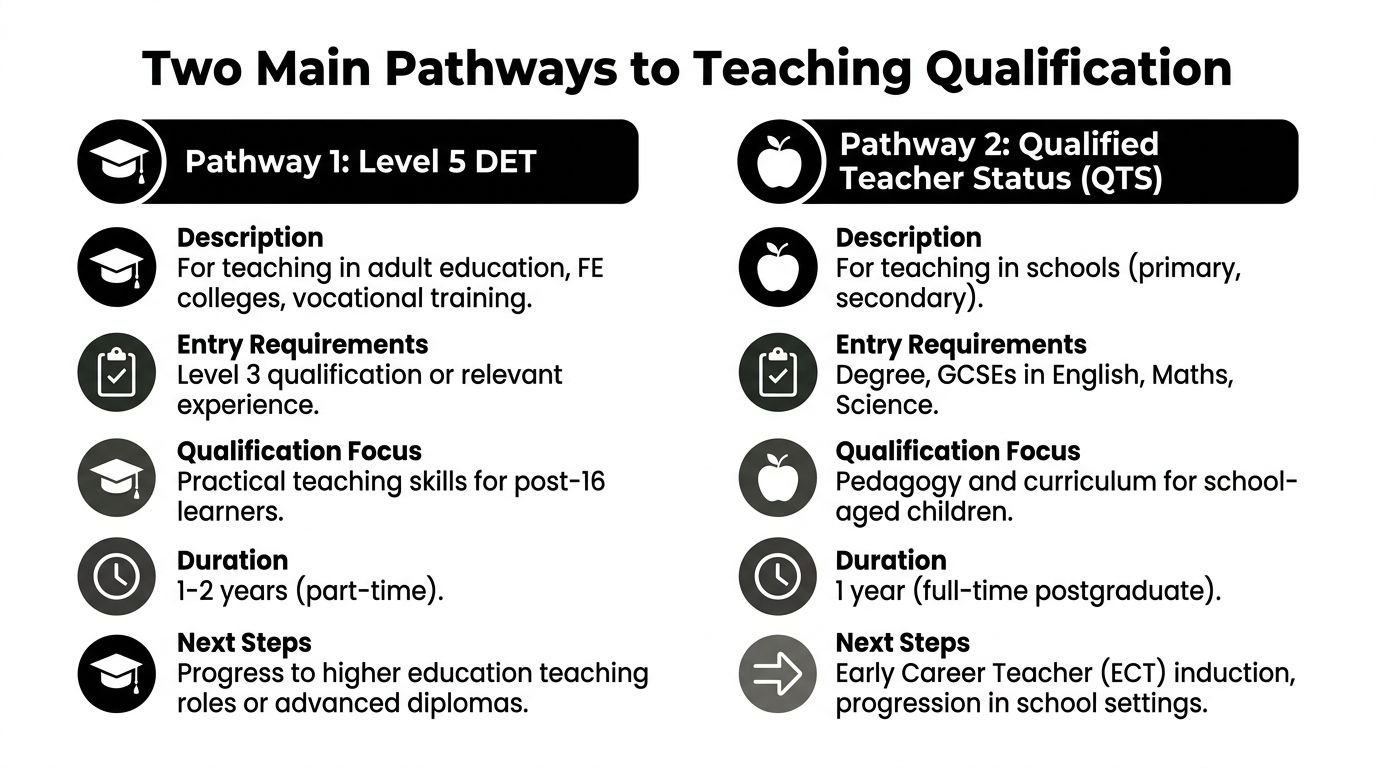
One route is the standard degree path into Qualified Teacher Status (QTS). The other is the non-degree path built around the Level 5 Diploma in Education and Training (DET), which can lead to Qualified Teacher Learning and Skills (QTLS).
The traditional route into QTS
For many school teaching jobs, the usual route starts with a bachelor's degree. After that, you complete approved teacher training and gain QTS. The UK government's guide to training to teach in England explains the main training options, including university and school-based routes.
This is the path many people picture when they hear the phrase "qualified teacher." It is widely recognised in primary and secondary schools.
If you do not have a degree yet, this route may still be possible later. It just is not the fastest starting point for someone who needs to build qualifications step by step.
The formal non-degree route
The route that makes more sense for many adult learners begins in further education, post-16 teaching, and vocational settings. That route centres on the DET.
The DET works like a professional teaching qualification for people who are building from practical experience and subject knowledge rather than from a university degree first. It is commonly taken through a college or training provider over one to two years, and it prepares you for teaching in further education and skills settings.
After the DET, you can work towards QTLS through professional formation with the Society for Education and Training. The Education and Training Foundation explains the QTLS process and its role in the further education sector.
That may sound like a lot of new language. Here is the simple version. QTS is the standard school route. DET to QTLS is the main formal route for people building toward teaching without starting with a degree.
What the DET and QTLS route looks like in real life
This route suits people who are often overlooked by traditional advice. Adults changing career. Teaching assistants who want to progress. Parents returning to study. Skilled workers who already know their subject and now want to teach it.
You do need a foundation in place before Level 5 study feels manageable. For many people, that means first sorting out English, maths, and study confidence. If you want a bridge into that stage, an Access to Higher Education teaching course can help you prepare for the academic side before starting the DET.
A few practical points matter here:
- English and maths: You usually need approved Level 2 qualifications in both.
- Teaching English or maths: You normally need a higher level in the subject you want to teach.
- Teaching practice: The DET includes a substantial teaching practice requirement, so real classroom experience still matters.
This is why the earlier step into support roles can be so helpful. It gives you evidence, confidence, and a clearer sense of whether teaching fits your life before you commit to formal training.
A clear comparison
| Route | Best fit for | Main starting point | End result |
|---|---|---|---|
| QTS | Primary and secondary school teaching | Degree, then teacher training | Qualified Teacher Status |
| DET to QTLS | Further education, post-16, and vocational teaching | Level 5 DET, teaching practice, and core entry qualifications | Qualified Teacher Learning and Skills |
Both routes can lead to respected teaching work. The right choice depends on where you are starting, not on your worth or ability.
If you do not have a degree today, the DET to QTLS path often gives you the clearest road forward. It lets you build in stages, prove to yourself that you can do this, and move toward a teaching career in a way that feels possible rather than overwhelming.
Getting the Qualifications You Need to Progress
For many adult learners, the biggest block isn't motivation. It's the fear of going back to study after a long break. English and maths can feel especially loaded. They often carry old memories of failure, embarrassment, or being told you were not academic.
That feeling is common, and it doesn't mean you can't do this.

Start with English and maths
To progress towards the Level 5 teaching route, you need approved Level 2 qualifications in English and maths. That could be GCSEs at grade 4 to 9, or Functional Skills Level 2, which are accepted alternatives for many adult learners.
If you want to teach English or maths as a subject, the bar is higher. You need Level 3 in that subject. This is one of those details that catches people out, so it's worth checking early.
A lot of adults do best when they focus on one subject first, gain a win, then move to the next. If that's you, starting with a flexible GCSE maths and English course for adults can make the process feel manageable rather than overwhelming.
Why adult-friendly study matters
You may be studying around work, childcare, or caring responsibilities. That means your course has to fit your real life, not an ideal version of it.
Good adult learning usually includes:
- Flexible study times: So you can learn early in the morning, late in the evening, or at weekends.
- Clear structure: So you always know what to do next.
- Support when confidence dips: Because most learners don't struggle with ability. They struggle with doubt.
- Practical progress checks: So you can see improvement instead of guessing.
If school didn't work for you the first time, that doesn't mean learning won't work now.
The Access to HE option
Some adults want more than minimum entry requirements. They want a proper academic bridge back into study. That's where an Access to Higher Education Diploma can help.
Access to HE courses were designed for adults returning to education. They can help you rebuild essay writing, study skills, reading confidence, and subject knowledge. If Level 5 study feels intimidating, Access to HE can make it feel possible.
This short video gives a useful sense of what returning to study can look like in practice.
Build the floor before the ceiling
You do not need to rush into the highest qualification straight away. Strong progress usually looks like this:
- Sort out English and maths first if you need them.
- Gain or continue classroom experience while studying.
- Take an Access to HE route if you need a stronger academic base.
- Move on to Level 5 study when you are ready for it.
That order matters because confidence often follows evidence. Each completed course tells you something important. You can learn. You can finish. You can cope with the next level.
For many parents, this part of the journey becomes emotional. You're not only passing exams. You're changing the story you tell yourself about what kind of person you are.
Your Action Plan From Today to Qualified Teacher
Big goals feel frightening when they sit in your head as one huge block. They feel more possible when they become a sequence. If you want a practical answer to how to become a teacher without a degree, think in stages, not leaps.
A realistic roadmap
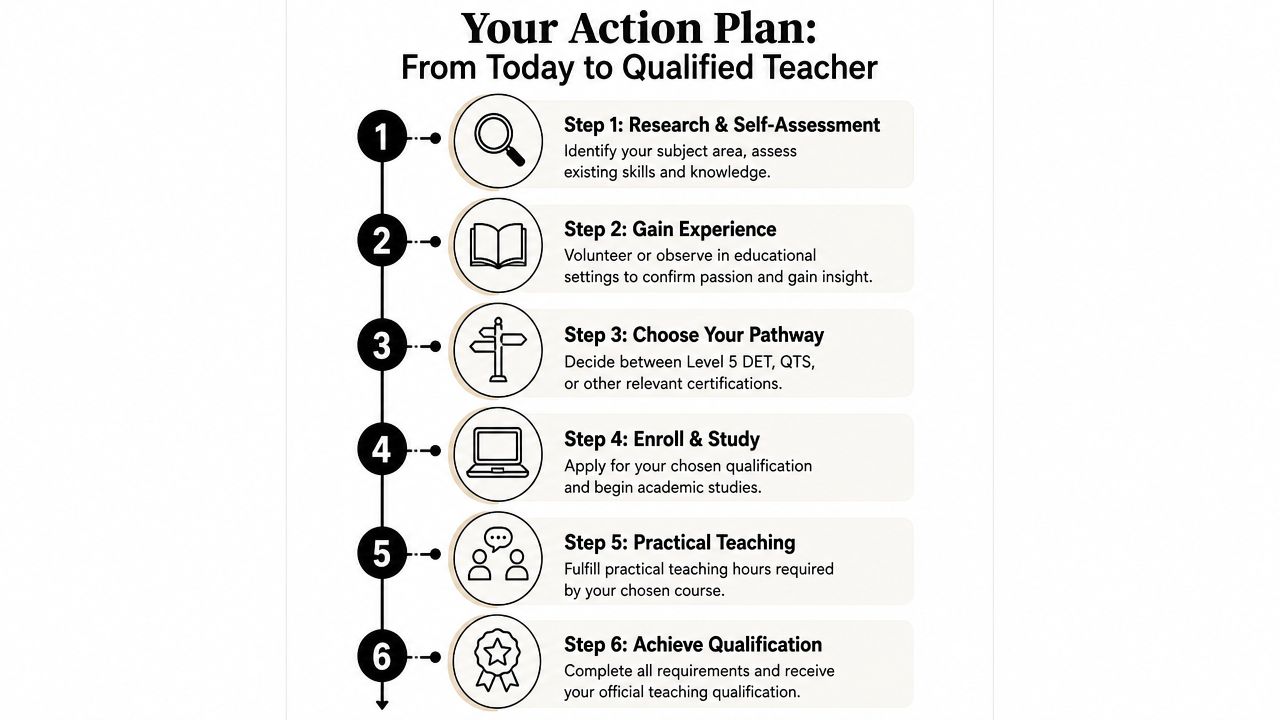
Here is a simple way to think about your path:
- Stage one: Get close to the classroom through a support role, tutoring, or volunteering.
- Stage two: Strengthen your core qualifications in English and maths if needed.
- Stage three: Add an Access to HE course if you want stronger academic preparation.
- Stage four: Begin the Level 5 Diploma in Education and Training once you meet the requirements.
- Stage five: Build your teaching practice and move towards QTLS.
Not everyone follows exactly the same order. Life gets in the way sometimes. That's normal. Progress still counts when it is steady rather than fast.
A sample timeline
Some learners find it easier to picture this as a rough timeline.
| Stage | What you might focus on |
|---|---|
| Early stage | Teaching Assistant, Cover Supervisor, tutoring, school volunteering |
| Next stage | English and maths qualifications |
| After that | Access to HE if you need academic confidence |
| Then | Level 5 DET and practical teaching hours |
| Final stage | Professional Formation and QTLS application |
This keeps the process grounded. You are not trying to become everything at once. You are building a professional life one layer at a time.
What to watch out for
The non-degree route is real, but it needs clear thinking. According to Key Skills Education's guide on becoming a teacher without a degree, QTLS is the only formal UK path to becoming a qualified teacher without a degree. The same guide also warns that while QTLS has official parity with QTS, there is 'no guarantee that schools will consider the QTLS qualification as equal to applicants holding QTS'.
That doesn't mean the route isn't worthwhile. It means you should build strong classroom experience alongside your qualifications, because employers often look closely at what you've done.
Strong evidence of teaching practice can make a big difference when your route is less familiar to an employer.
Think practically about money and support
Cost matters. Time matters too. Adult learners often need to make decisions that work for the whole household.
A useful way to approach this is to ask:
- Can I study while working? Part-time and online options often make that possible.
- Can I spread the journey out? Many people do better when they focus on one qualification at a time.
- What funding might apply to my course? Some learners look into options such as the Advanced Learner Loan for eligible study.
- What support will keep me going when life gets messy? The right provider matters more than many people realise.
Your action plan doesn't have to look impressive on paper. It has to be realistic enough to survive your real life.
You Can Be the Teacher You Wish You Had
Many adults come back to learning with a quiet sadness. They remember being overlooked, rushed, or made to feel incapable. Part of becoming a teacher is healing that old wound. You get to become the calm, patient adult you might have needed yourself.
That matters in classrooms. It matters at home too.
The route may begin with small steps. A support role. An English course. Maths revision at the kitchen table. Then more doors open. Experience grows. Qualifications follow. For people asking how to become a teacher without a degree, the path is not instant, but it is real. With the right preparation, the DET and QTLS route can turn determination into a recognised professional direction.
Your family won't just see certificates. They'll see courage. They'll see you keeping your word to yourself. They'll see what it looks like when an adult chooses growth instead of staying stuck.
And one day, a learner in front of you may succeed because you didn't give up on your own future first.
Take the first step while it still feels small. That might be asking for advice, checking your English and maths level, or exploring the course that gets you moving again. You do not need to have the whole journey sorted today. You only need to begin.
If you're ready to take that first step, Next Level Online College offers flexible online study for adults who want to rebuild confidence, gain recognised qualifications, and move towards a better future in education and beyond.