
You've finished a shift, sorted dinner, helped with homework and finally opened your folder of notes. The pages look familiar, but your mind feels tired. You read the same paragraph twice, highlight a few lines and wonder whether any of it will stay in your memory.
If that sounds like you, you're not failing. You're an adult learner trying to study around real responsibilities. Learning and Work Institute reports that 21% of adults are currently learning, while lack of confidence was reported by 19% of learners in 2025, compared with 13% the year before (Learning and Work Institute adult participation survey). Feeling rusty after time away from education is common.
The answer isn't to punish yourself with longer evenings. It's to learn how to revise effectively by using your limited time for activities that strengthen memory, expose gaps and prepare you for the way your exam will test you.
What Revising Effectively Actually Means
Effective revision isn't measured by hours at a desk. It isn't the number of pages you highlight, the length of your notes or the number of revision videos you watch. Those activities can feel productive because the information is in front of you, but recognition isn't the same as being able to produce an answer alone.
A UK revision-time survey found that 37% of learners' revision time was spent on low-utility activities, including rereading, highlighting and note-making. It also found that 76% of Years 10 to 13 weren't spacing revision consistently (UK revision-time survey). Adults can fall into the same trap, especially when returning to study and looking for a gentle way to begin.
Make each session active
Active revision asks your brain to do something without constant support from the page. You might:
- Recall key ideas: Close the book and write what you remember about a topic.
- Explain a process: Talk through an answer aloud as if you're helping your child understand it.
- Solve from memory: Attempt a maths question before checking the worked example.
- Correct your work: Compare your answer with the mark scheme and identify what was missing.
A useful session has a clear outcome. “Study biology” is too broad, but “recall the stages of digestion and correct two missing explanations” gives you something you can complete.
Practical rule: Start with what you can remember, then use your notes to repair what you missed.
Know what revision can and can't do
Revision strengthens knowledge you've already started learning. If a topic is completely new, you may need to learn the basic content first, then revise it through recall and practice. Exam preparation adds another layer, because you must also practise working with time limits, question wording, mark schemes and the pressure of sitting in an exam room.
You may feel nervous, behind or embarrassed that simple facts have slipped away. None of that tells you what you're capable of achieving. A short, repeated study habit with honest feedback will take you further than one exhausting burst followed by several days of avoidance.
Diagnosing What You Really Need to Revise
Don't begin with the largest pile of notes. Begin with the course specification, because it shows the knowledge and skills your qualification expects. Break it into topics and create three simple categories: secure, uncertain and not yet covered.
You can use traffic-light colours:
| Colour | Meaning | Your next action |
|---|---|---|
| Green | You can recall and apply the idea | Check it occasionally |
| Amber | You recognise it but struggle alone | Use recall and targeted questions |
| Red | You can't explain or use it yet | Learn the basics, then practise |
This isn't a judgement about your intelligence. It's a map. A red topic gives you somewhere useful to start.
Let questions reveal the real gaps
Past papers show how your subject is assessed. Look for:
- Command words, such as describe, explain, compare or evaluate.
- Mark allocation, so you understand how much detail an answer needs.
- Time expectations, especially for longer responses.
- Repeated question patterns, including the types of evidence, calculations or conclusions expected.
Try a small number of questions before you revise the whole topic. Then mark your answers against the published mark scheme, rather than awarding yourself marks because an answer “sounds about right”.
For example, a GCSE maths answer might use the correct method but lose marks because a calculation step is missing. An English response might make a sensible point but need clearer evidence and explanation. These findings are more useful than a general feeling that you're “bad at maths” or “not good at essays”.
Turn diagnosis into a short action list
Group your findings into three lists:
- Must learn, the facts, processes or vocabulary you can't yet recall.
- Must practise, the skills where you understand the idea but lose marks applying it.
- Already secure, the material you can retrieve and use correctly.
Prioritise gaps that appear in several question types or affect many marks. Create a checkpoint for each one, such as explaining a process without notes, recalling important dates or applying a formula to an unfamiliar problem.
Update the list after practice. Confidence can hide weak recall, while one difficult attempt can make a topic seem worse than it is. Your aim is not to label yourself permanently. Your aim is to notice improvement and choose the next sensible task.
Building a Revision Timetable That Fits Real Life
A useful timetable starts with your actual life, not an imaginary day with no shifts, school runs or housework. Write down work, childcare, travel, medical appointments, household responsibilities and the times when you normally have the most energy.
Protect sleep and recovery before filling every available gap. Then choose short, focused sessions with one clear purpose. A 20-minute session can be worthwhile if you spend it recalling a process or completing one question. A longer session can become unhelpful if you spend most of it rereading without testing yourself.
Match the task to your energy
Use your strongest periods for difficult or unfamiliar topics. Save lower-energy periods for flashcards, short recall quizzes, reviewing corrections or organising questions for the next session.
Colour-coding can make the week easier to read. Add a buffer for a delayed shift, an unwell child or a task that takes longer than expected. Leave at least one evening flexible, because a timetable that collapses after one missed session quickly damages confidence.
For planning support, you can use these study planner templates to organise sessions around your commitments.
A realistic sample week
| Day | Focus |
|---|---|
| Monday | 30 minutes of closed-book recall |
| Tuesday | One GCSE maths past-paper question |
| Wednesday | Interleaved history questions from different topics |
| Thursday | Rest or a flexible catch-up slot |
| Friday | Mark answers and write a gap list |
| Saturday | Two protected study sessions with a proper break |
| Sunday | Rest, or a light review if you choose |
This is only a model. Your week may need to look different. The important features are active recall, spaced returns, mixed practice and exam questions, rather than the exact days.
Review the plan before each week begins. If your shifts change, move the task instead of treating the change as failure. Keep a small urgent-gap list so unexpected free time has a purpose.
Measure success through completed targets, stronger recall, corrected answers and improved timed performance. Hours alone don't tell you whether revision worked.
The Three Techniques That Make Revision Stick
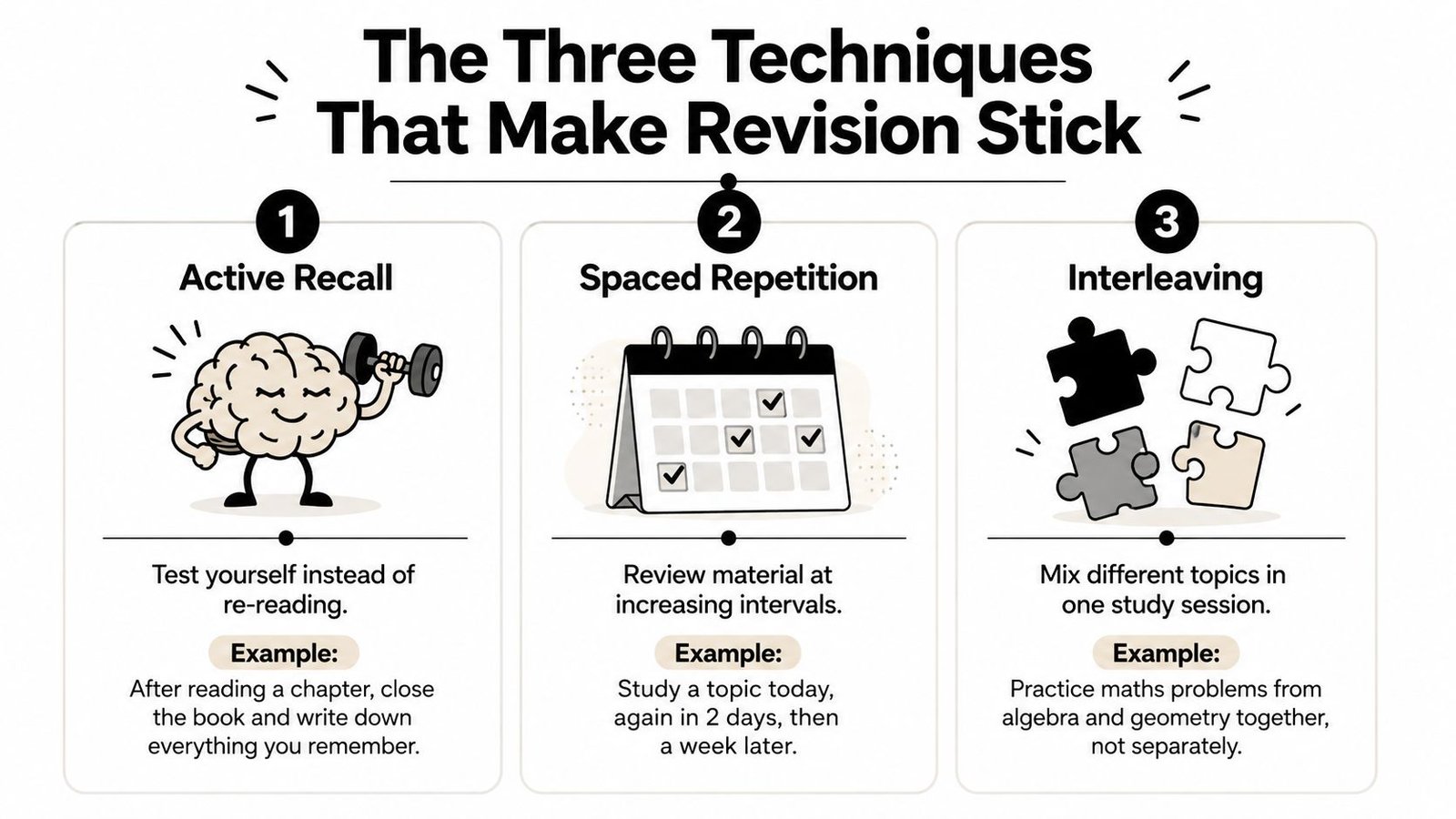
Three habits form the foundation of effective revision: active recall, spaced repetition and interleaving. Independent UK-facing guidance ranks retrieval practice and spaced practice among the highest-utility methods, and recommends repeated cycles of planning, spacing, testing, redrafting and practising under exam conditions (evidence-based revision guidance).
Active recall means answering before looking
Read a short part of your notes, close the book and retrieve the main ideas. For the causes of the English Civil War, you could write everything you remember about the conflict between the Crown and Parliament, then check your notes and add what was missing.
The common mistake is to leave the book open and copy sentences. That improves familiarity, but it doesn't show whether you can produce an answer independently.
Spaced repetition means returning later
Review a topic after a gap rather than studying it once for a long time. You might test yourself on balancing chemical equations today, revisit the same skill after a few days and return again later in the week.
The delay matters because it makes recall effortful. Cramming can make information feel fresh for a short time, but repeated retrieval with spacing supports longer-term learning. A UK-based evidence review reported that, among 317 studies on spaced learning, all but 12 showed a benefit (UK-based evidence review).
Interleaving means mixing related work
Instead of spending a whole evening on one type of maths problem, mix algebra and geometry questions. In history, alternate questions about different events rather than completing every question on one period first.
Interleaving feels harder because you must decide which method or idea applies. That difficulty is useful preparation for an exam, where nobody tells you which topic to use.
You don't need a complicated app to begin. Paper cards, a notebook or a simple digital tool can work. If you want further ideas for combining retrieval with practical study habits, this guide explains ways to boost retention and cut study time.
Use the three habits together: recall a topic, return to it after a gap, then mix it with other topics and questions. For a broader set of active methods, see these active learning strategies.
Using Past Papers and Exam Practice the Right Way
Past papers shouldn't wait until the final days. They can show you what to learn, how questions are worded and where marks disappear. Your first attempt is not a verdict on your ability. It's a diagnostic snapshot.
Start gently, then add pressure
Find official papers and mark schemes through your exam board's website. If a full paper feels too intimidating, choose a small group of questions from one topic first.
Use this sequence:
- Source official material: Choose the correct subject, level and paper.
- Attempt questions: Begin untimed if you're still learning the method, then use timed practice later.
- Mark strictly: Follow the mark scheme and examiner guidance rather than giving yourself generous marks.
- Create an action: Turn each lost mark into a topic, skill or answer-structure task.
The first attempt may take longer than expected. That's useful information, not proof that you've left it too late.
Turn mistakes into specific tasks
Suppose a GCSE maths question goes wrong because you chose the wrong method. Your next task might be to practise recognising that question type, followed by another example without notes.
If an English Language extended response scores poorly, don't write “improve English” in your planner. Write a precise task such as planning an argument, selecting evidence or developing explanation in each paragraph.
You can also compare attempts. Keep the original answer, correction and later attempt together. This lets you see whether you're recalling more, choosing methods faster and including the details the mark scheme rewards.
Space exam practice across your revision period. Some learners also explore tools such as AI for exam questions, but use any generated question carefully and check it against your specification and official assessment materials.
Work calmly. Marking isn't there to shame you. It tells you what to do next.
Sleep, Stress and Motivation as Part of Revision
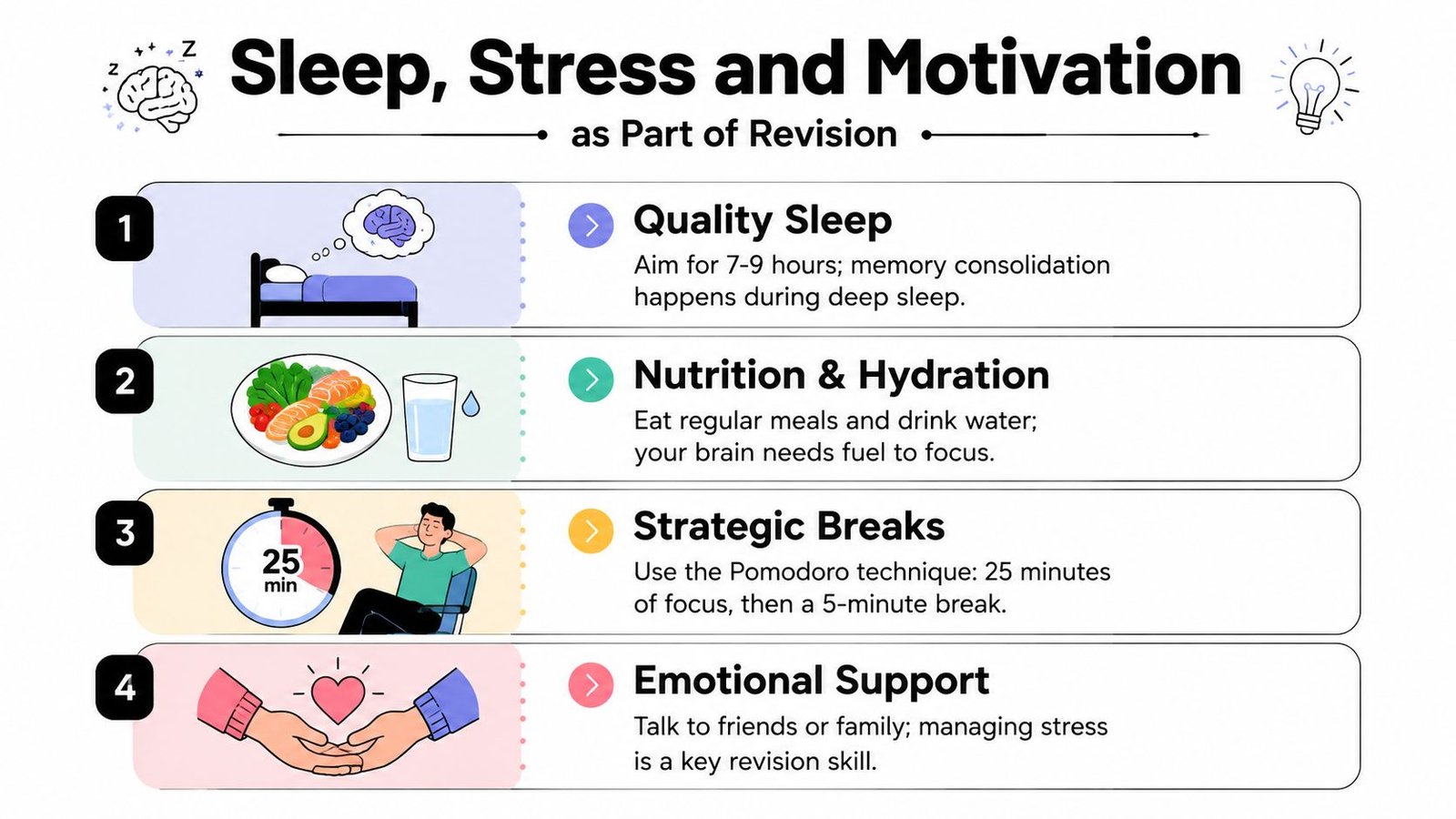
Sleep, food, water and breaks aren't rewards you earn after revision. They create the conditions that allow your brain to focus, retrieve information and cope with mistakes. When you're exhausted or panicking, even a well-planned session can produce very little useful learning.
Protect a regular sleep routine where possible. Build short movement breaks into study, keep water nearby and eat something simple before you become distracted by hunger. You don't need a perfect lifestyle. You need enough care to give your mind a fair chance.
Make motivation easier to access
Tell one trusted person what you're working towards. That might be a partner, friend, parent or child. They don't need to test you every night. Knowing that someone understands your plan can make it easier to restart after a difficult day.
The guilt can feel strong. You may wonder whether study time takes you away from your family, especially when you're trying to set an example for your children. Remember that working towards education can show them that learning belongs at every age and that progress can begin with one small decision.
Stress also deserves a plan. If your thoughts race, write down the worry, choose one tiny task and set a short timer. You can stop when it ends, or continue if you feel settled. A missed session doesn't erase previous work.
You can find further practical ideas for building motivation for studying when confidence is low.
This short video offers another way to think about revision habits and staying focused:
Be kind but honest with yourself. Rest supports revision. It doesn't compete with it.
Your Next Step Towards a Proud Result
You now have a practical system for how to revise effectively:
- Clear aims: Decide what you'll recall, practise or correct.
- Diagnosis: Use the specification and questions to find real gaps.
- A realistic timetable: Fit study around shifts, childcare, travel and energy.
- Three memory habits: Use active recall, spaced repetition and interleaving.
- Past-paper practice: Mark carefully and turn lost marks into actions.
- Supported wellbeing: Protect sleep, breaks, food, confidence and encouragement.
Progress matters more than perfection. A single corrected answer may look small, but it proves that you can find a weakness and improve it. Over time, those small wins can help you become a positive role model for your children, move towards a fulfilling career and take steps towards university.
Adult learners can choose different routes. Next Level Online College offers GCSE English Language and Maths, GCSE Combined Science, A Level subjects including Psychology, Biology and Business, Functional Skills English and Maths from Entry Level through Level 2, and Accredited Distance Learning courses that can support UCAS or employment applications.
Functional Skills maths has a clear progression route. Government guidance says Entry Levels 1, 2 and 3 focus on simple problems in familiar situations, while success can provide skills for further study at Levels 1 and 2. Levels 1 and 2 are designed to prepare learners for work, study and life (government Functional Skills maths subject content). The qualifications are regulated by Ofqual, and the reformed requirements apply to learners registered on or after 1 September 2019, with qualifications awarded on or after 1 August 2021 covered by the updated rules (government Functional Skills mathematics guidance).
If university is your aim, Access to Higher Education is a nationally recognised Level 3 qualification for adults preparing for higher education. It's regulated by the Quality Assurance Agency for Higher Education and is available in England, Wales and Northern Ireland. The Access to HE website reports that over 20,000 students achieve the diploma and progress to university courses across the UK each year, and that 46% of people registered in 2017 to 2018 were aged over 25 (Access to HE information).
Next Level Online College's enrolment flow includes a free initial assessment, a personalised study plan, dedicated tutor support and flexible online study designed to fit around shifts and childcare. This week, download your specification, book an assessment or tell someone in your family that you're starting. Your result can become more than a grade. It can be evidence to your children, your future employer and yourself that you kept going.
Next Level Online College offers flexible online GCSEs, A Levels, Functional Skills and Access to Higher Education routes with tutor support for adult learners. Visit Next Level Online College to arrange your free initial assessment and take the first practical step towards a qualification you can feel proud of.