
Going back to study can feel heavy. You might be reading this after work, with the washing still to do, your phone buzzing, and a quiet worry in the back of your mind that says, “What if I've left it too late?” If that sounds familiar, you're not alone.
GCSE Geography is still within reach. You don't need perfect conditions, long empty days, or a brilliant memory from the start. You need a plan that fits real life, a few smart revision habits, and the belief that this qualification can open doors for you and set a powerful example for your children.
Your Time to Shine with GCSE Geography
To revise for Geography GCSE as an adult, start with this truth. Feeling nervous doesn't mean you can't do it. It usually means this matters to you.
Many adult learners carry extra weight into study. Work deadlines. School runs. Bills. Family care. Past experiences at school that knocked confidence. That can make revision feel bigger than it really is. But geography is a subject you can build step by step, and every topic you learn adds to your confidence.
Why this GCSE matters beyond the exam
A GCSE isn't just a grade on paper. For many adults, it's proof that they can come back stronger. It can help with further study, support a move into better-paid work, and show your family what persistence looks like in real life.
In England for 2025, 67.1% of all GCSE students achieved grade 4 or above across all subjects, while 23.0% achieved grade 7 or above, according to Tutorful's summary of adult GCSE outcomes. A solid pass is a realistic, worthwhile target, and it's the outcome many capable learners achieve.
You don't need to be the fastest learner in the room. You need to keep going when life gets busy.
Confidence grows from action
Low confidence often tells people to wait until they “feel ready”. That rarely works. Confidence usually grows after a few small wins, not before them.
Try thinking about revision in a simpler way:
- One topic at a time: You don't need to master the whole course this week.
- One short session at a time: Even a focused burst can move you forward.
- One improvement at a time: Better notes, clearer case studies, stronger exam answers.
If your children see you revising, showing up, and refusing to give up, they learn something far bigger than geography. They learn resilience. That example can stay with them for years.
Build Your Winning Revision Blueprint
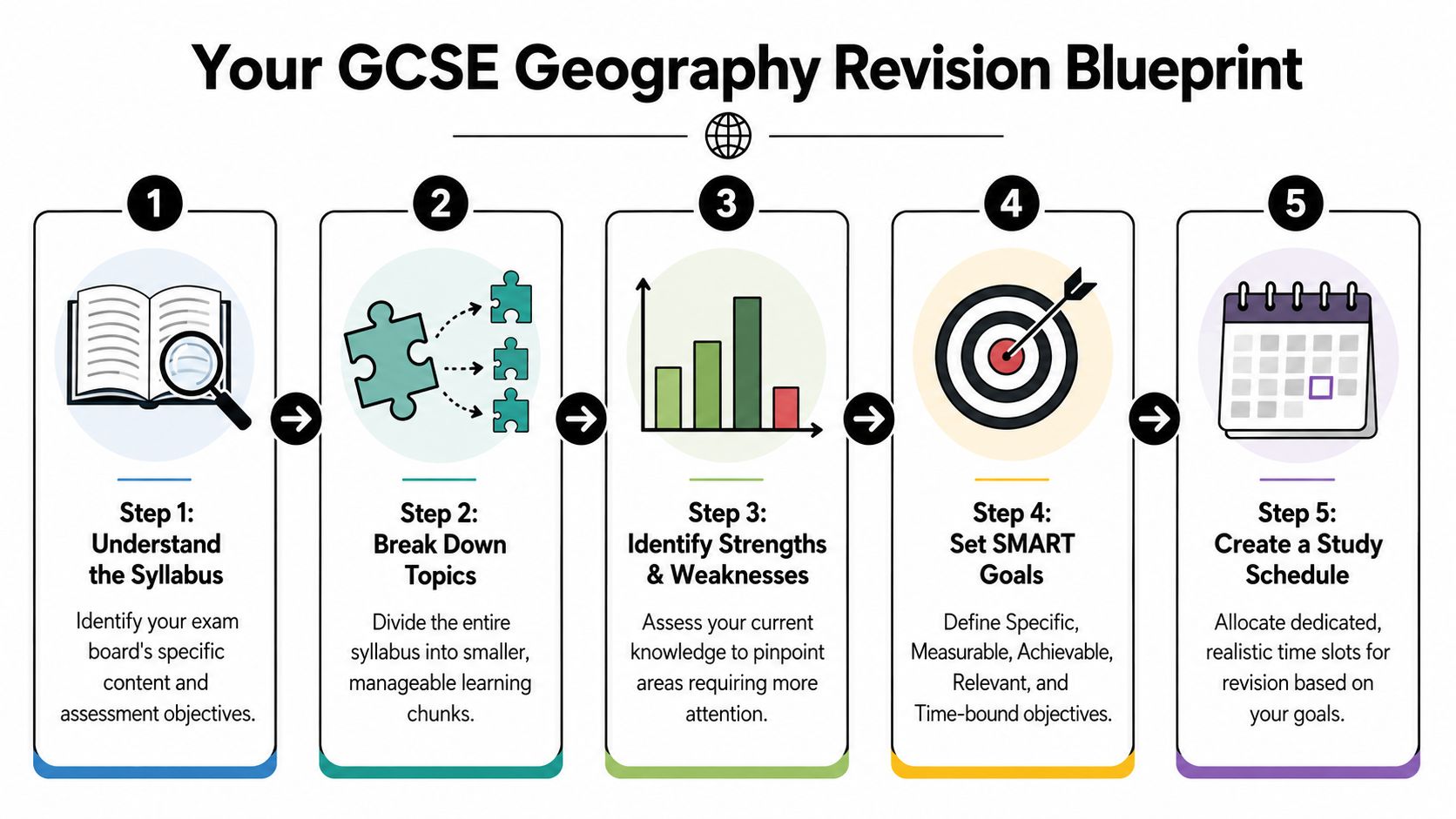
The fastest way to feel calmer is to stop treating Geography as one huge subject. Break it into parts you can manage. A syllabus isn't a scary document. It's a map.
Start with your exam board
Before you revise anything, check which exam board you're studying. For many learners that will be AQA, though some courses use other boards. Your course details, textbook, or exam entry information should tell you.
Once you know the board, print the specification or save it on your phone. Then turn it into a checklist. Geography becomes much easier when you can see the separate areas in front of you instead of holding them all in your head.
A simple breakdown might include:
- Physical geography: natural hazards, rivers, coasts, ecosystems
- Human geography: urban issues, economic change, resources
- Geographical skills: maps, graphs, statistics, fieldwork, case studies
Turn the syllabus into a weekly plan
Don't build a timetable for an imaginary version of you who wakes up early every day and never gets interrupted. Build one for your actual life.
Use a planner with small, realistic blocks. If you need one, these study planner templates can help you organise your week in a simple visual way.
Here's a practical approach:
- List every topic from your specification.
- Mark each one as secure, shaky, or not started.
- Pick three priorities for this week only.
- Assign short slots around work and family time.
- Leave breathing space for delays, tired days, and catch-up.
Practical rule: A good timetable is one you can keep using. A perfect timetable that collapses after two days isn't helping you.
Build a revision map you can see
Some adults work best when they can track progress clearly. A wall chart, notebook page, or simple spreadsheet can do the job.
| Topic area | How confident do you feel | What to do next |
|---|---|---|
| Rivers | Low | Watch a lesson and make summary notes |
| Urban issues | Medium | Learn one case study and answer questions |
| Fieldwork | Low | Review methods and data types |
| Resource management | High | Practise past paper answers |
That visual progress matters. It gives you proof that you're moving, even when progress feels slow.
Revision Techniques That Genuinely Work
A lot of learners think revision means reading the same page again and again. It feels productive because you're looking at the material. But if you close the book and can't recall it, the page didn't really stick.
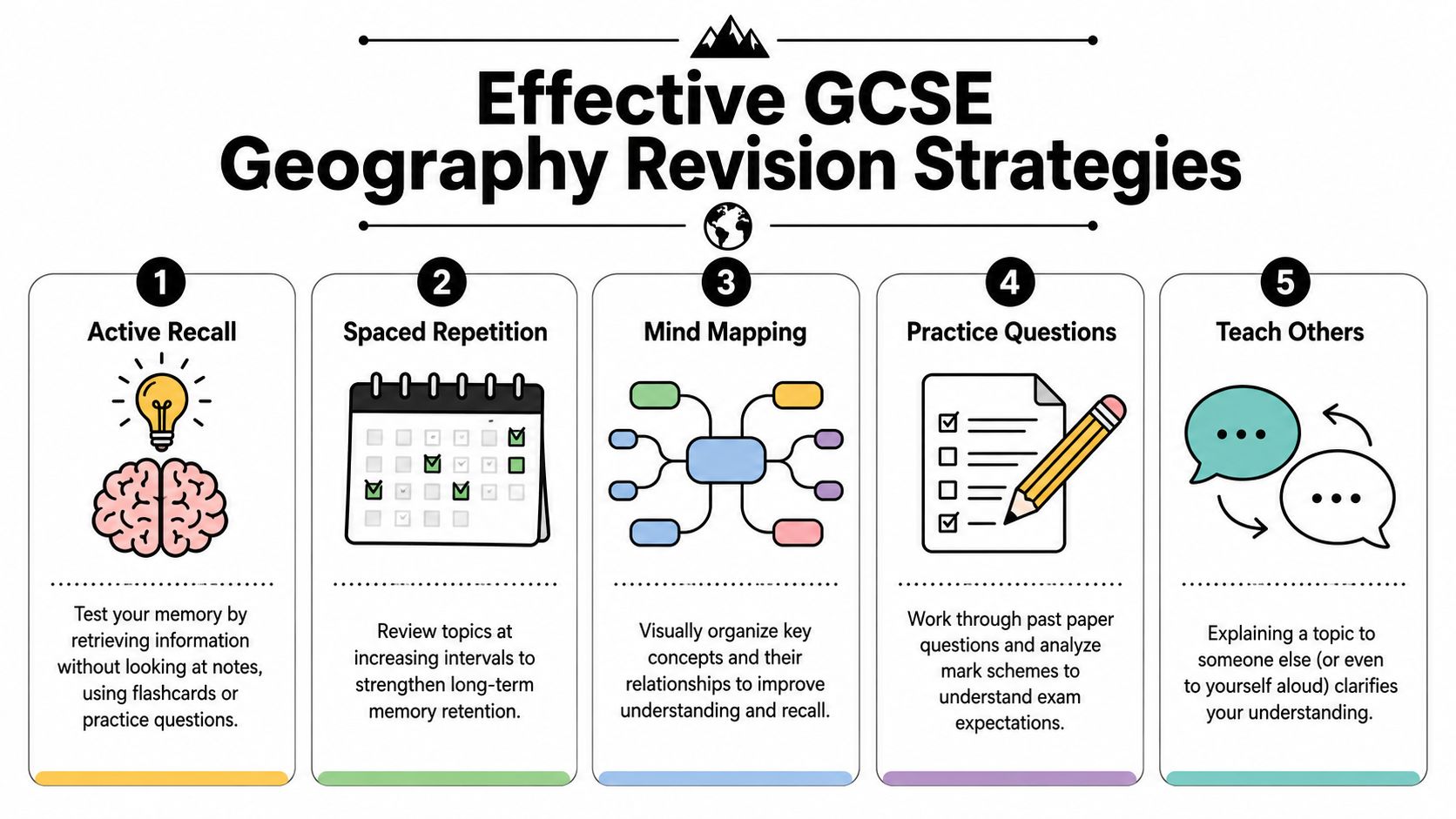
The better approach is active revision. That means pulling information out of your memory, not just pushing your eyes over it.
Use notes as a starting point, not the finish line
A useful method is to make your own short notes first. Then change them into something more visual and easier to remember.
A YouTube revision guide on GCSE Geography methods says that turning personalised notes into visual diagrams such as flowcharts or mind maps can enhance memory retention by 40% compared to linear notes, and doing a weekly brain dump on blank paper can increase active retention scores by 35%.
That matters because geography contains chains of cause and effect. A mind map can show links much more clearly than a dense paragraph.
Three methods to use this week
If you want a practical answer to how to revise for Geography GCSE, use these methods first.
- Flashcards for key terms: Put the word on one side and the meaning or example on the other. Good for erosion, urbanisation, migration, sustainability, and case study facts.
- Brain dumps: Close your book and write everything you can remember about one topic on blank paper. Then check what you missed.
- Mind maps and flowcharts: Use them for processes, comparisons, and case study structure.
For more active methods you can apply straight away, these GCSE revision techniques are especially useful when your study time is limited.
Make revision more memorable
Try this simple comparison.
| Passive habit | Active habit |
|---|---|
| Re-reading a page | Covering the page and recalling it |
| Highlighting everything | Picking only the key words |
| Watching a video once | Watching, pausing, then writing from memory |
| Looking over case studies | Explaining them aloud without notes |
If you can explain a topic simply, you probably understand it. If you can only recognise it when you see the page, you need another round of active recall.
You can even teach the topic to yourself out loud while making tea. That sounds small, but it forces your brain to organise the knowledge properly.
Mastering Geography Case Studies and Fieldwork
Case studies often worry adults because they seem like long lists of facts. Fieldwork can feel worse because the words sound technical. Both become much easier when you use a fixed structure.
A simple case study template
For each case study, write your notes under the same headings every time:
- What happened or what is the issue
- What caused it
- What effects it had
- How people responded
That structure helps you answer many exam questions because examiners often want causes, effects, and responses. Keep your case study notes short enough to revise quickly. One page per case study is often enough if it's well organised.
A clear layout like this can help:
- Event or place: name the case study
- Causes: physical, human, or both
- Effects: social, economic, environmental
- Responses: immediate actions and longer-term actions
Fieldwork in plain English
Fieldwork becomes clearer once you know the difference between quantitative and qualitative data.
According to SimpleStudy's AQA fieldwork revision notes, quantitative data means measurable numbers, while qualitative data means opinions and observations. So a river depth reading is quantitative. An interview answer about how local people feel about traffic is qualitative.
That same guidance also explains that reliability can improve when several students assess the same place and use the mode, meaning the most common score, to reduce subjectivity in a survey.
Sampling and statistics without panic
Fieldwork questions can also ask about methods.
Here's a quick guide:
- Random sampling: every location has an equal chance of being chosen
- Systematic sampling: locations are picked at regular intervals
- Stratified sampling: different parts of an area are sampled proportionally so all area types are represented
- Mean, median, and mode: these are core statistical skills in GCSE Geography, as covered in BBC Bitesize's geography statistics revision
If those words used to make you switch off, don't worry. You don't need to become a statistician. You just need to know what each method does and when it might be useful.
Using Past Papers to Perfect Your Exam Skills
Past papers are where revision starts to feel real. They show you what the exam asks, how marks are given, and where your knowledge is still too vague.
Many learners make one big mistake. They “revise” by reading notes for ages, then feel shocked when they struggle to answer a question. That's not a sign you've failed. It's a sign you need a more active routine.
Learn from the paper before you fear it
Internet Geography's revision techniques page warns that reading notes without a purpose results in a 0% success rate for long-term recall, while the SCANNING technique followed by immediate recall writing can boost retention to 65% within 24 hours.
That's why past papers work so well. They give your revision a purpose. You're no longer just looking at information. You're using it.
A calm way to begin is this:
- Start open-book: answer questions with your notes beside you
- Check the mark scheme: see what earned marks
- Rewrite one answer: improve it while the lesson is fresh
- Move to timed questions later: build speed once your structure improves
Examiners reward clear answers that match the question. Knowledge helps, but only if you use it in the right way.
Command words matter
Many marks are lost because the answer doesn't match the command word.
| Command word | What it usually means |
|---|---|
| Describe | Say what you can see or what happened |
| Explain | Give reasons why |
| Compare | Show similarities and differences |
| Evaluate | Judge how successful or important something is |
If a question says explain, a list usually won't be enough. If it says evaluate, you need a judgement, not just facts.
Review your mistakes properly
Don't just mark an answer wrong and move on. Ask:
- Did I misunderstand the question?
- Did I know the content but not apply it?
- Did I forget a case study example?
- Did I stop too early for the number of marks?
That kind of review turns every paper into training, not just testing.
Fitting Your Revision into a Busy Life
Adult learners rarely struggle because they don't care. They struggle because life is full. You might have twenty spare minutes, but not two spare hours. That changes how revision needs to work.
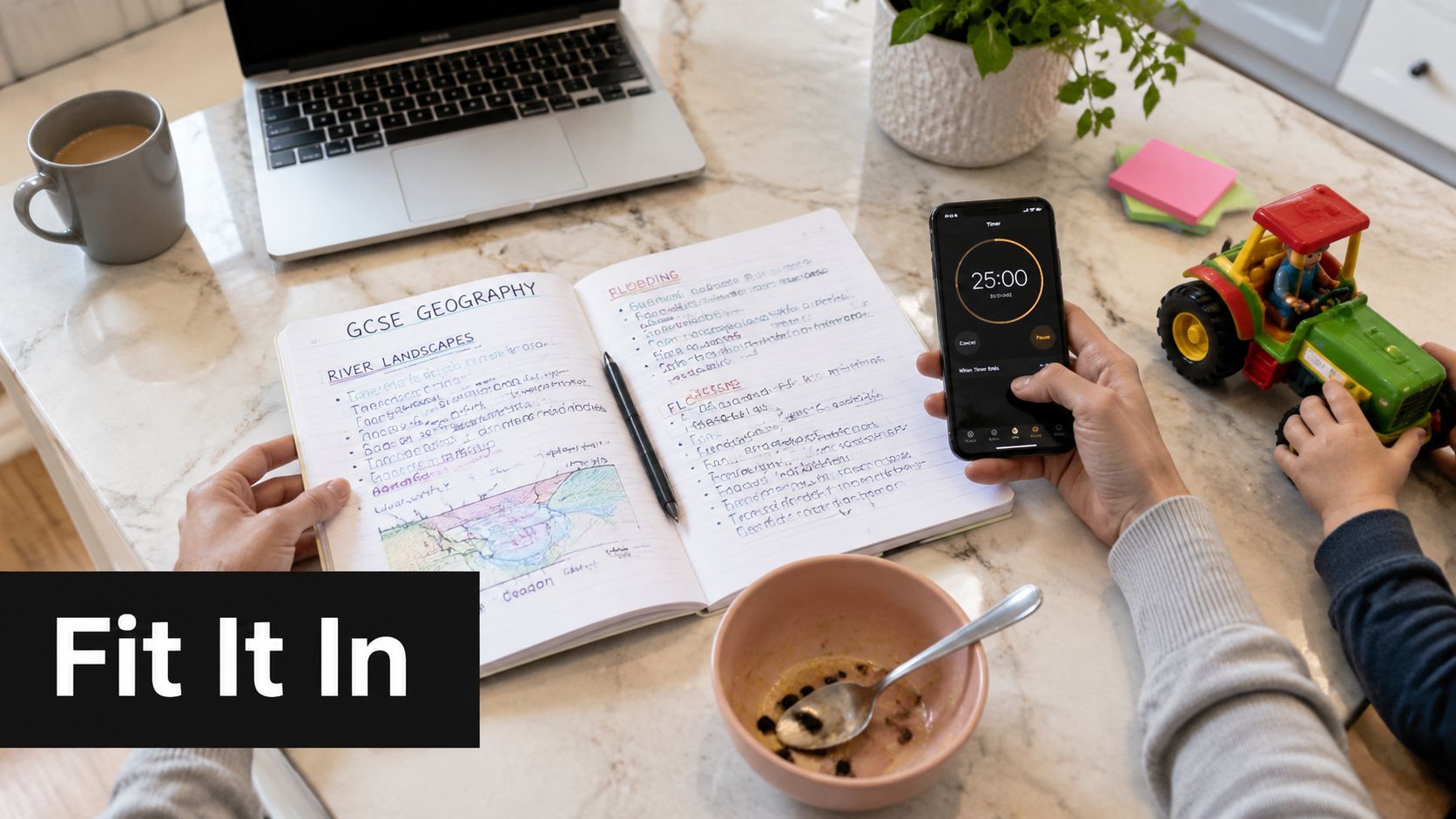
Ofsted data from 2024 shows that 68% of UK adult learners cite time fragmentation as their primary barrier to study, and mainstream resources often don't offer modular 15-minute micro-revision strategies for shift workers or parents, as noted by Save My Exams' discussion of revision barriers for adult learners.
Use revision snacks instead of waiting for a perfect evening
A short session can still be powerful if it has one clear job.
Try these micro-revision ideas:
- 15 minutes at lunch: revise one case study heading
- 10 minutes in the car before pickup: test yourself on key terms
- While dinner cooks: do a quick brain dump on rivers or hazards
- Before bed: answer one short exam question
Effective planning is key. Practical time management for students can make those small pockets of time easier to spot and protect.
A realistic weekly pattern
Busy adults often do better with rhythm than rigid rules. For example, a parent working full time might use weekdays for tiny sessions and one longer slot at the weekend.
A simple pattern could look like this:
| Day | Revision idea |
|---|---|
| Monday | 15 minutes of flashcards |
| Tuesday | 20 minutes on one case study |
| Wednesday | Rest or catch-up |
| Thursday | One short practice question |
| Friday | Review mistakes from Thursday |
| Weekend | One longer session for notes and planning |
That pattern leaves room for real life. If a child gets ill or work runs late, you haven't lost everything.
Here's a helpful video to watch when you need a fresh push:
Let the people around you help
You don't have to do this alone. Tell your family when you're studying. Ask for one protected slot each week. Put your revision times where everyone can see them.
A small supportive action can make a real difference. A UK text message intervention for adult students increased average attendance by 4% in the first weeks and led to an 8% higher likelihood of passing exams, according to this Behavioural Insights Team working paper on texting adult learners.
That's a useful reminder. Encouragement matters. A short message, a reminder, or a quiet half hour can help you keep going.
Your Path to Success and a Proud Future
Passing GCSE Geography won't only show that you learned about rivers, cities, hazards, and fieldwork. It will show that you stayed committed while carrying adult responsibilities. That matters.
There will be days when revision feels slow. That doesn't mean you're falling behind. It means you're doing something difficult and worthwhile. Every page of notes, every practice question, and every short study session is evidence that you're building a new future on purpose.
Your success can change more than your own life
Children notice effort. They notice when a parent keeps going. They notice when learning matters at home.
In Lewisham, targeted adult learner courses led to 60% of students achieving grade 4 or above in maths, compared with 15% nationally in further education, showing what can happen with the right support. The same report also highlights how adult learners can become role models for their children, as shown in this account of adult learner success from the Association of Learning.
Your qualification can become part of your family story. Not because it was easy, but because you chose not to give up.
Keep your reason close
When motivation drops, return to your reason. Maybe you want to move towards university. Maybe you want a better job. Maybe you want to prove to yourself that your school years didn't define your future.
All of those reasons count.
Geography rewards consistent effort. If you build a clear plan, use active revision, practise with past papers, and fit study into the life you already have, this exam becomes far more manageable. You don't need to be perfect. You need to be steady.
If you're ready to turn good intentions into real progress, Next Level Online College offers flexible online learning designed for adults balancing study with work and family life. With supportive teaching, recognised qualifications, and a strong focus on confidence-building, it can help you move towards GCSE success, further study, and a future your family will feel proud of.