
You may be sitting at the kitchen table after a long day, looking at university courses or new careers and wondering whether returning to education is realistic. Perhaps you left school years ago, your confidence has fallen, or family responsibilities have always come first. Media Studies A Level can give you a clear, recognised route back into learning, while helping you develop practical skills for creative work.
You don't need to feel like a natural essay writer or a technology expert. With steady support, organised study and a reason that matters to you, you can build the qualification, confidence and experience needed for your next step.
Why Media Studies A Level Could Change Your Life
A parent might begin by helping their child with homework, then notice a familiar feeling returning. They miss learning. They have ideas for films, campaigns, news stories or online content, but no qualification to help turn those ideas into opportunities. Enrolling on Media Studies A Level can be the first practical move towards university, a career change or a more purposeful working life.
The subject is firmly part of mainstream UK education. Provisional Media, Film and TV Studies entries reached 34,210 in summer 2026, compared with 32,555 in summer 2025, while England accounted for 20,975 entries in 2026, according to the UK government's provisional exam entries data. JCQ recorded 23,320 UK entries in the 2025 exam series, compared with 22,990 in 2024, showing that participation has continued after the pandemic.

A qualification your family can see you earn
Your children may not remember every hour you spend revising, but they'll notice that you kept going. They'll see you read, plan, submit work and prepare for exams, even when life feels busy. That example can change how your whole family views education.
Media Studies A Level can also support applications for university courses connected with journalism, communications, advertising, film, television and digital media. It won't guarantee a particular job or salary, but it can give you the academic foundation and practical confidence to compete for your next opportunity.
The subject also welcomes different strengths. You might be better at spotting how a news story is framed than memorising long passages. You may have strong ideas but need help expressing them clearly. Production work gives you another way to show planning, creativity and judgement.
A useful way to think about it: you're not too late. You're bringing adult experience, curiosity and real knowledge of the world into a subject built around communication and culture.
What You Will Actually Study and Learn
Media Studies A Level looks at the messages people meet every day and the choices behind them. Official subject guidance includes television, film, radio, newspapers, magazines, advertising and marketing, online and social media, video games and music video. The exact texts and assessment tasks depend on your awarding body, so always check the specification used by your provider.
Start with media language. This means examining how images, sound, colour, layout, editing, words and design create meaning. A newspaper homepage may use a large photograph, a short headline and a dramatic colour scheme to draw attention. A music video may use camera movement, costume and editing to build an artist's identity.
Next, study representation. Ask how a group, place, age, gender or social issue is shown. Is the portrayal complex, stereotyped, positive or negative? Who gets to speak? Which viewpoints are missing? These questions help you understand how media can influence public conversations.
Then consider the business behind the product.
- Industries: Explore ownership, regulation, technology, production and distribution.
- Audiences: Examine how media companies identify, attract and retain particular groups.
- Convergence: Study how one product can move between television, websites, apps, social platforms and other channels.
- Production: Plan and create your own media work, making decisions about purpose, audience, form and style.
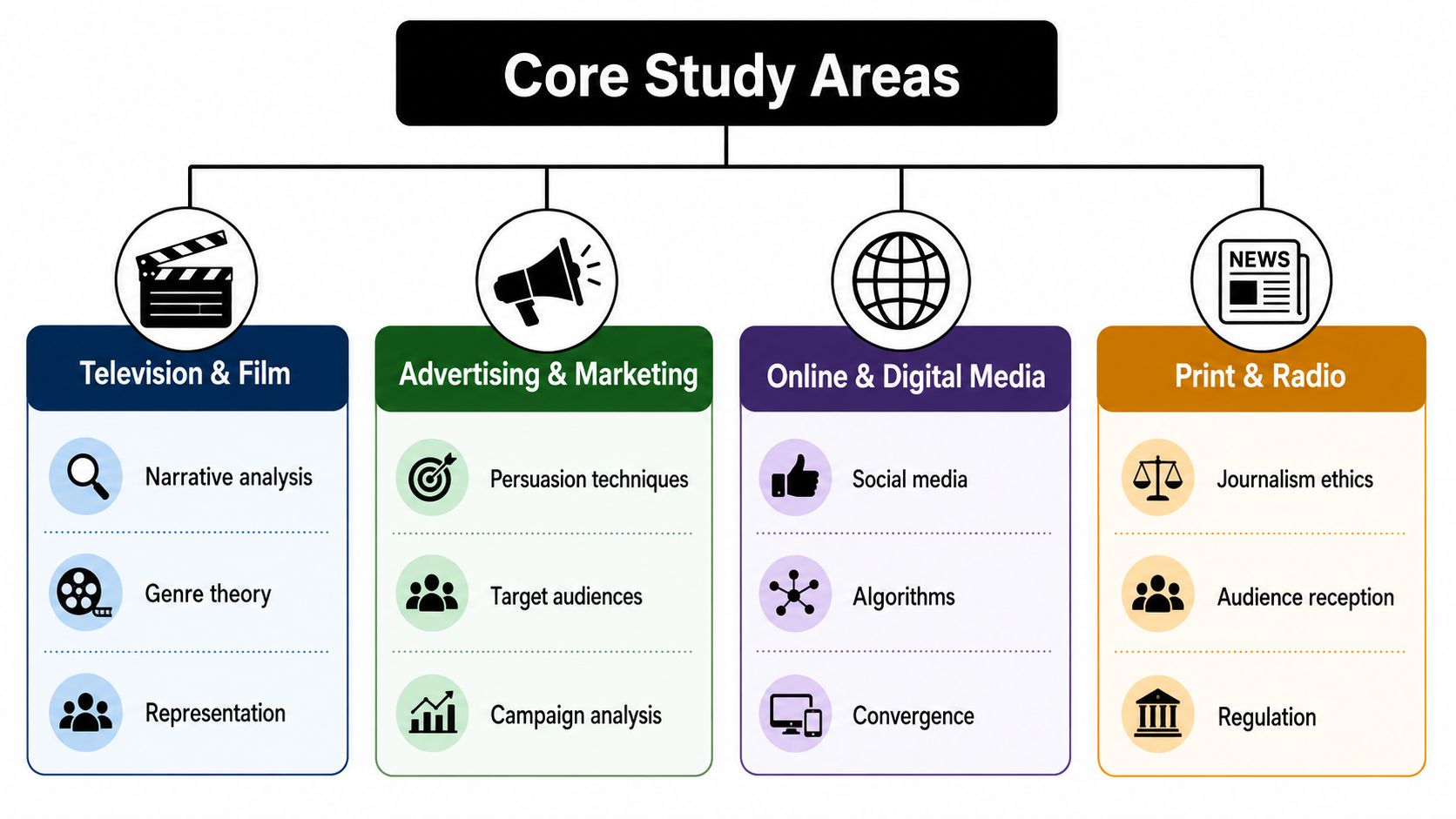
OCR's A Level Media Studies H409 specification shows how the course combines textual analysis, institutional study and production. Its structure is 70% external examination and 30% non-exam assessment, so preparation needs to cover both written answers and practical work.
AQA also uses a framework built around media language, representation, industries and audiences, with compulsory study across forms such as advertising, music video, radio, newspapers and film. That means you won't memorise separate case studies. You'll learn to connect a product's design with its audience, ownership, purpose and social context.
How You Will Be Assessed and Graded
Assessment can feel less frightening once you know what each part asks you to do. AQA's structure contains three components worth 35%, 35% and 30%. It includes two written papers and a non-exam assessment, so your final result isn't based only on one exam room experience. The AQA scheme of assessment gives the component weightings and marks in detail.
AQA's written papers are each two hours and marked out of 84. The NEA is marked out of 60 and scaled to 72, making a total scaled qualification mark of 240. Your answers need more than opinions. Strong responses use precise media terminology, relevant examples, clear explanations and links to the question.
A clear benchmark for planning
The following table shows AQA's published June 2025 grade boundaries. The percentages are calculated from the maximum mark of 240, rounded to the nearest whole number.
| Grade | Marks Required | Percentage |
|---|---|---|
| A* | Not published in the supplied boundary data | Not calculated |
| A | 184 | 77% |
| B | 156 | 65% |
| C | 129 | 54% |
| D | 102 | 43% |
| E | 75 | 31% |
The published June 2025 AQA Media Studies boundaries list 184 marks for an A, 156 for a B, 129 for a C, 102 for a D and 75 for an E. Boundaries can change, so treat them as a guide rather than a promise about a future result.
Where adult learners can gain marks
The NEA suits learners who prefer time to research, plan and improve a piece of work. You may create a media product and explain the decisions behind it, rather than responding to every demand under timed conditions.
For exams, practise a repeatable process:
- Identify the question's key words.
- Name a precise example.
- Analyse the media language or representation.
- Connect the point to industry, audience or context.
- Finish by answering the question directly.
AQA's Media Studies specification sets out the exam and NEA requirements. Read it early, because knowing the assessment criteria helps you spend your limited study time on work that can earn marks.
Skills That Lead to Well-Paid Creative Careers
Media Studies A Level is useful because it teaches you to notice, question, create and explain. Those abilities transfer beyond a classroom. A journalist needs to assess information and communicate clearly. A digital marketer needs to understand an audience and shape a message. A production assistant needs organisation, teamwork and careful attention to detail.
The course can also help you discover which type of work suits you. You might enjoy investigating how a story is built, creating visual content, planning a campaign or managing the practical details behind a production. These are different directions, but they all rely on disciplined thinking.
Skills with a real workplace purpose
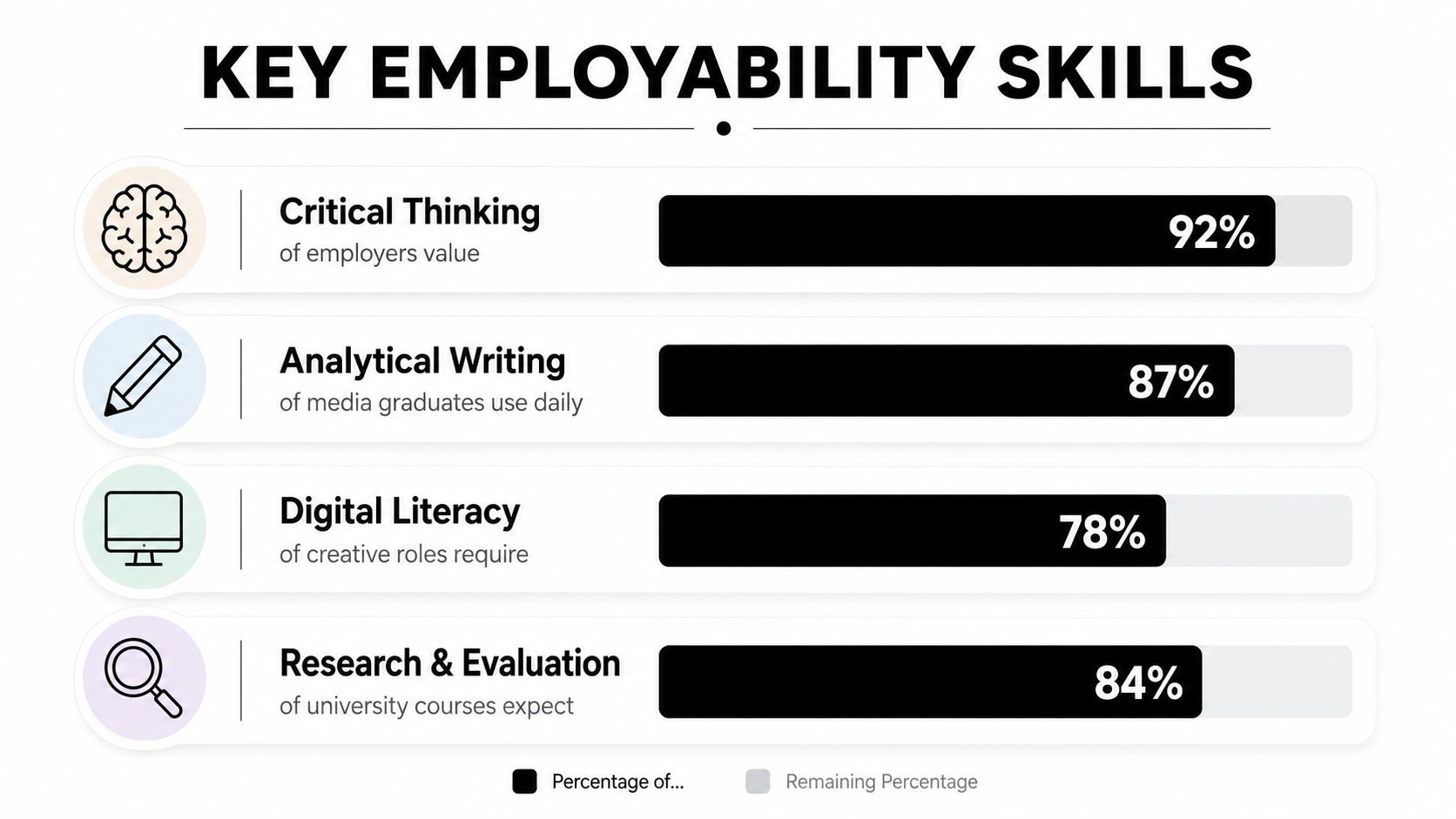
Critical thinking helps you separate evidence from assumption. That matters in journalism, public relations, communications and social research.
Analytical writing teaches you to make a point, support it and explain why it matters. The same habit helps with campaign reports, scripts, briefs and professional emails.
Digital literacy gives you a stronger understanding of platforms, formats, audiences and production choices. You won't become an expert in every software package automatically, but you'll have a useful foundation for learning tools such as Canva, Adobe Photoshop or Premiere Pro.
Research and evaluation help you plan responsibly. You'll learn to compare sources, understand context and judge whether a media choice achieved its purpose.
Possible pathways include journalism, content creation, advertising, public relations, social media management, digital marketing, film production, television production and communications. Some roles may require university study, specialist training or experience as well. The A Level is a foundation, not a guarantee, but it can make your next application more credible and focused.
A documentary career, for example, may combine research, storytelling, organisation and production support. The documentary filmmaking career account from Wheaton College describes work involving archival materials, editing, coordination and problem-solving. That example shows why creative careers need practical reliability as well as imagination.
Career mindset: choose a direction that connects your strengths with a problem people need solved. Creative work becomes more sustainable when you can communicate, organise and deliver reliably.
Choosing the Right Provider and Funding Your Studies
The provider you choose can shape your experience as much as the subject itself. Adult learners need clear answers before enrolling, especially if they work, care for children or have had a difficult experience with education in the past.
Check these points before making a decision:
- Awarding body: Ask which board will issue the qualification and whether the provider explains its current specification.
- Tutor access: Find out how quickly tutors normally respond and whether feedback covers both essays and practical work.
- Assessment arrangements: Confirm how exams, coursework deadlines and any required attendance are handled.
- Study format: Check whether lessons, resources and support work on a phone or laptop, and whether you can study at times that suit your household.
- Progression advice: Look for guidance on university applications, personal statements, portfolios and related career routes.
Don't judge a course only by its price. Compare the support included, the clarity of the timetable and the practical help available when you get stuck. A low-cost option may become expensive in time and stress if you have to solve every problem alone.
Make the money plan concrete
Write down the full cost, including tuition, examination fees, travel if required and equipment. Ask whether the provider offers instalments, and speak to your employer if the qualification supports your current role or a planned career change. You should also check current eligibility rules for public funding, because support depends on personal circumstances and the course route.
Advanced Learner Loans may be relevant for eligible learners on eligible courses, but don't assume that every A Level or provider qualifies. Ask for written information and check the official conditions before committing.
Treat funding as part of your study plan, not an embarrassing subject. A calm conversation about cost can prevent pressure later and help you choose a realistic pace.
Study Strategies That Work for Busy Adult Learners
A busy adult doesn't need a perfect routine. You need a routine that survives real life. One learner may study after the school run, another during a lunch break, and someone else may use a quiet hour after work. The strongest plan is the one you can repeat without exhausting yourself.
Start with the week in front of you. Mark work shifts, family commitments and fixed appointments first. Then choose small study blocks and protect them where possible. If a child is ill or work changes suddenly, move the session rather than deciding that the whole week has failed.
A practical routine for limited time
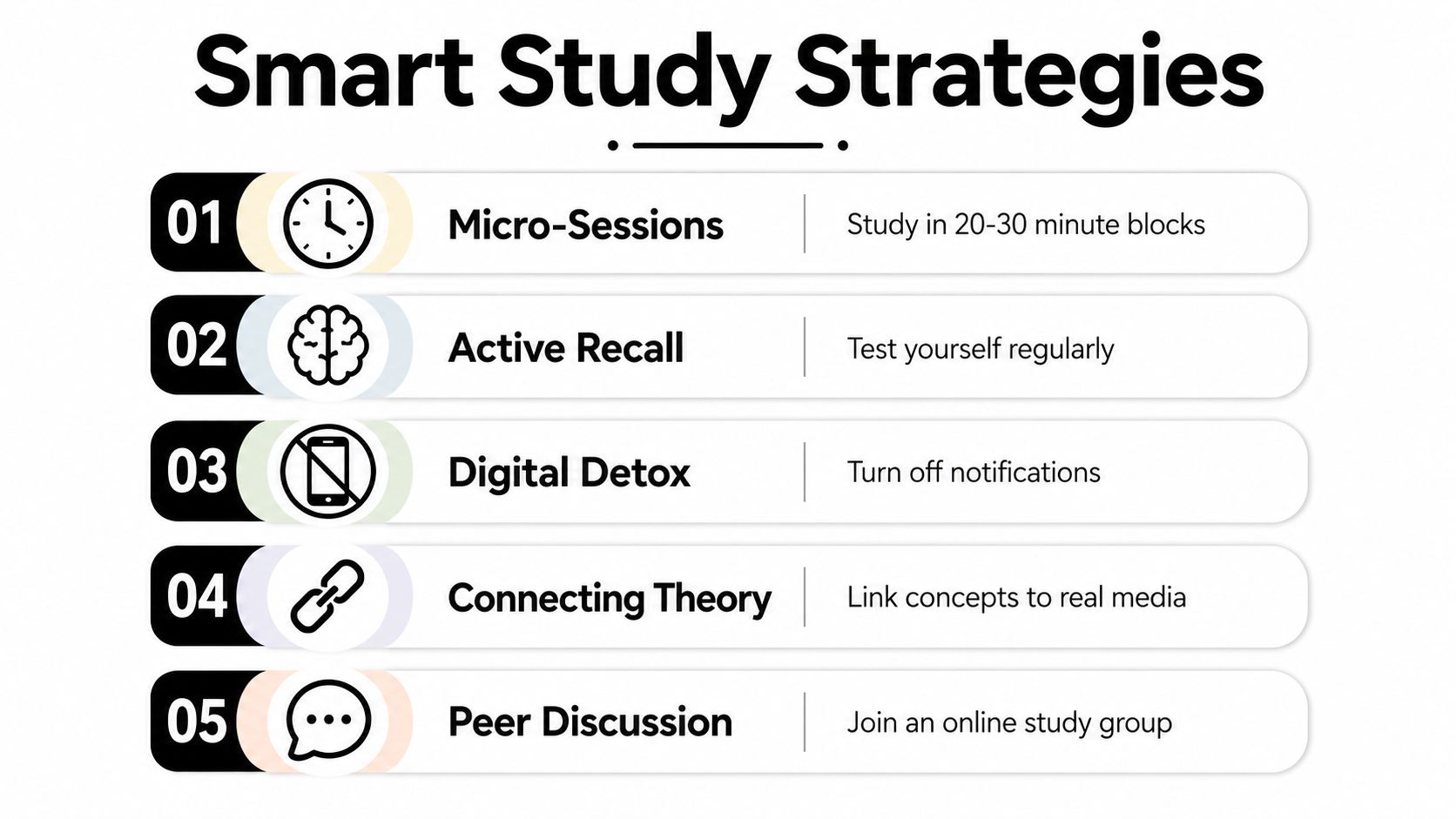
Use micro-sessions for vocabulary, flashcards or one short paragraph plan. During a longer session, study one topic rather than opening every unit at once.
Try this pattern:
- Recall: Close your notes and write what you remember about representation or media language.
- Apply: Use a real product, such as a news website, poster or music video, and identify the choices you can see.
- Explain: Write a short paragraph linking the example to audience, industry or context.
- Review: Compare your work with the mark scheme or tutor feedback and improve one weakness.
Keep notifications off during focused work. A phone can be useful for accessing resources, but constant alerts make it harder to hold an argument in your mind. Store notes in clearly named folders so that you can find your specification, case studies and draft work quickly.
Time management for students can help you build a study plan around your actual commitments rather than an imaginary week with no interruptions.
Make confidence part of the evidence
Keep a simple progress record. Write down the date, task completed and one thing you understand better. On a difficult day, that record proves that progress is happening even when it feels slow.
Study with other learners if you can. Explaining a theory to someone else often reveals what you know, while listening to their example can help you see a media product differently. If you use artificial intelligence tools for research or revision, check the information carefully and follow your awarding body's rules. OCR's guidance on AI in Media and Film Studies warns that submitted assessment work must show your own knowledge and decisions.
Your Journey from Enrollment to Career Success
Your route begins with a practical check, not a leap into the unknown. Confirm the awarding body, entry requirements, assessment dates, study format and support available. Then create a weekly plan that gives your course a regular place in your life.
During the early stage, focus on core vocabulary and short analytical paragraphs. You don't need to understand every theory immediately. As your knowledge grows, you'll connect media language with representation, audiences and industries, then use those connections in longer answers.
The production stage rewards organisation. Keep drafts, research notes, planning documents and feedback together. Record why you chose a particular image, layout, sound, platform or audience. This habit makes improvement easier and helps you explain your choices clearly.
From results to your next opportunity
When results arrive, use them as information, not as a verdict on your worth. A pass can support progression, while stronger grades may help with applications to relevant university courses. If your result isn't what you hoped for, speak with your provider about resits, alternative qualifications or an appropriate career change course.
Your next step might be a degree in journalism, film, marketing, communications or digital media. It might be an entry-level production role, an apprenticeship, freelance content work or further training. Build evidence as you go, such as a portfolio, writing samples, campaign ideas or production work that follows the relevant rules.
Remember: your children don't need to see a perfect journey. They need to see an adult respond to difficulty with patience, honesty and persistence.
Returning to education can change more than your CV. It can restore trust in your own ability, give your family a new story about learning and help you move towards work that feels worthwhile. You deserve a route that respects your responsibilities while still expecting you to grow.
Next Level Online College offers flexible, supported online study for adult learners working towards recognised qualifications and progression into further study or new careers. Visit Next Level Online College to explore how Media Studies A Level or a related creative pathway could fit around your family, work and future plans.