
You might be reading this after work, with dinner still to sort, emails still coming in, and a quiet worry sitting in the back of your mind. You know A Level Chemistry could open a door. University. A new career. Better pay. A chance to prove to yourself, and to your children, that it isn't too late.
That feeling is more common than you think. Nearly half of all adults in the UK (49%) have taken part in learning within the last three years, with 28% currently learning and 21% having learned recently, according to FE Week's reporting on adult learning participation. You are not the odd one out. You are part of a huge group of adults choosing growth over regret.
If you're searching for an online A Level Chemistry tutor, don't treat it like a last-minute fix. Treat it like the first serious move towards the future you want.
Why a Great Tutor Is Your Secret to Success
A lot of adults think getting a tutor means they've failed before they've even started. That's the wrong way to see it.
A strong tutor is not a rescue plan. They are a shortcut to clarity, confidence, and structure. Chemistry is hard because it builds on itself. If atomic structure feels shaky, bonding gets messy. If bonding is unclear, organic chemistry can feel impossible. A good tutor stops that domino effect early.

Tutoring is a smart move, not a shameful one
Adults returning to education carry more than textbooks. You might also be carrying old school memories, self-doubt, and the fear of looking foolish. That's exactly why the right support matters.
A tutor gives you three things self-study often can't:
- A calm explanation: They can break a topic down without making you feel behind.
- A clear route forward: They help you focus on what matters instead of drowning in notes.
- Belief: They remind you that struggling with a topic doesn't mean you're bad at learning.
Practical rule: If a tutor only teaches chemistry and never builds confidence, they're only doing half the job.
This is especially important if your life is already busy. Adults don't need more pressure. They need a plan that offers practical solutions. That's why a support model built around personalised learning plans makes far more sense than random sessions with no wider direction.
Your family notices more than you think
When you sit down to study after a long day, your children see that. When you keep going after a hard week, your family sees that too. You become proof that goals matter, effort matters, and change is possible.
That's one reason this journey can be so powerful. Getting help with Chemistry isn't only about passing an exam. It's about becoming the kind of person who finishes what they start. That example can stay with your family for years.
A great tutor helps you get marks, yes. More than that, they help you keep going long enough to earn them.
Where to Find Your Perfect Chemistry Match
There are two main ways to find an online A Level Chemistry tutor. You can use a tutor marketplace, or you can study through a structured online college.
Both can work. They are not equal.
Tutor marketplaces give you choice
The UK tutor market is huge. Platforms list over 202,460 chemistry tutors, and specialist A Level tutors typically charge between £20 and £70 per hour depending on experience and exam-board specialism, as outlined by Tutopiya's overview of Cambridge International A Level Chemistry tutors in the UK.
That sounds brilliant at first. More choice should mean better odds of finding the right person.
Sometimes it does. But choice also creates work.
With a marketplace, you usually have to do all of this yourself:
- Check qualifications: Not every chemistry tutor is right for A Level.
- Check exam board fit: AQA, OCR, and Cambridge International each need slightly different handling.
- Judge teaching style: A strong degree doesn't guarantee clear teaching.
- Build your own study plan: Many tutors teach the lesson and leave the rest to you.
If you're confident, organised, and happy to manage the process, marketplaces can be useful. If you're already stretched thin, they can become another job.
Structured online colleges give you support around the tutor
Many adults find greater success with a structured provider. A structured provider doesn't just give you a person on screen for an hour. It gives you a framework.
That usually means:
| Option | What you get | Best for |
|---|---|---|
| Marketplace | Large choice, flexible booking, varied prices | Independent learners who want to self-manage |
| Structured online college | Tutor support, course structure, wider academic and pastoral help | Adults who want guidance as well as teaching |
When Chemistry sits inside a full course, your tutor isn't working in isolation. The teaching links to the syllabus, deadlines, revision, and often wider learner support. That matters more than people realise.
A booking system is not the same thing as a support system.
Which route should you choose
Be honest with yourself, not optimistic in a way that sets you up to struggle.
Choose a marketplace if you already know your exam board, can spot quality quickly, and will definitely organise your own study around work and family.
Choose a more supported route if you want your online learning wrapped inside a real course structure such as A Levels online in the UK. That setup is usually better for adults who need momentum, reassurance, and a clear path from week one.
The best choice is the one you can stick with.
What to Look for Beyond a Good CV
A tutor can have impressive qualifications and still be the wrong fit for you.
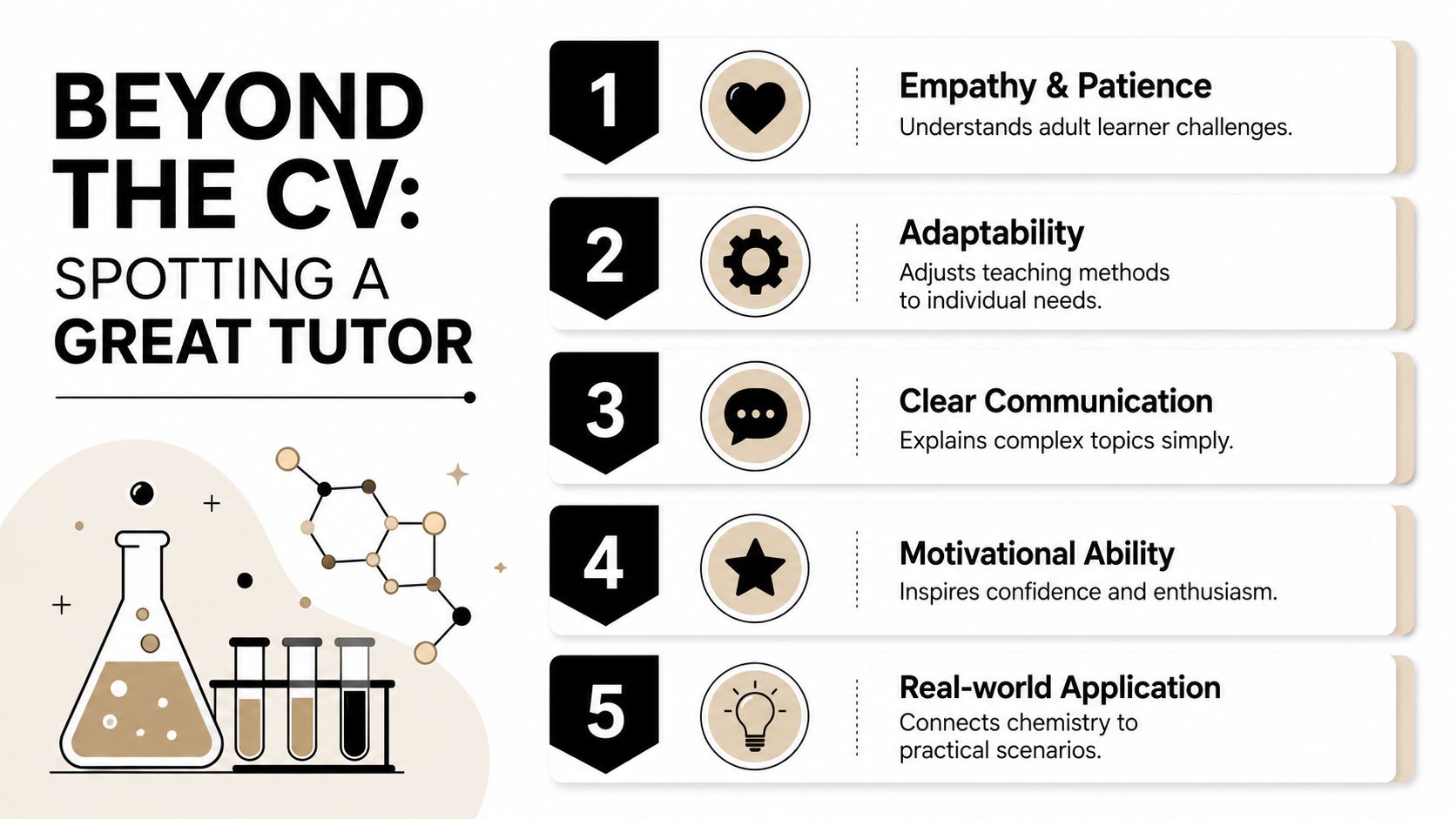
That's the truth many adult learners only discover after wasting money. A good CV matters, but it doesn't tell you whether someone can teach a tired parent on a Tuesday night, or support a nervous learner who hasn't studied science in years.
The non-negotiables
Start with the basics. Your tutor should absolutely have strong subject knowledge and direct A Level teaching experience.
Then check the things most learners forget:
- Adult learner experience: Teaching teenagers in school is not the same as teaching adults with gaps in confidence.
- Exam board knowledge: Your tutor should know your board well enough to guide your revision properly.
- Simple explanations: Chemistry is full of technical language. A good tutor makes it understandable.
- Patience: You need someone who stays calm when you need something explained twice.
- Reliability: If your routine is built around a tutor, they need to show up prepared and on time.
Practical work matters more than people expect
One issue gets ignored far too often in online Chemistry. The theory gets plenty of attention. The practical side doesn't.
That's a problem because 42% of UK A-Level Chemistry resits in 2025 stemmed from inadequate practical exposure in online settings, according to Chemistry A Level Tutor's analysis of the practical chemistry gap. If your tutor cannot explain practical methods, required experiments, observations, and exam-board expectations clearly, you are taking a risk.
Ask how they handle:
- required practicals
- experimental technique
- common mistakes in write-ups
- analysis of results
- differences between exam boards
A tutor who brushes this off is not thinking ahead.
The right tutor doesn't just help you answer questions. They help you understand what the exam is really testing.
Green flags and red flags
Here's the quick test.
Green flags
- They ask about your goals before talking about themselves.
- They explain a difficult idea in plain English.
- They mention your exam board without sounding vague.
- They talk about confidence and routine, not only grades.
Red flags
- They rely on jargon to sound clever.
- They promise fast results without asking about your starting point.
- They have no clear answer on practical chemistry.
- They treat your timetable like it should revolve around theirs.
You do not need the fanciest tutor. You need the one who can teach you well, fit your life, and help you believe you can do this.
Your Taster Lesson and Interview Checklist
A trial lesson is not a performance where you sit and hope for the best. It's an interview. You are checking whether this person deserves a place in your week, your budget, and your future.
That mindset changes everything.
Go in with questions, not just hopes
Many adults choose a tutor because the profile sounds polished. Then they realise, too late, that the tutor has no clear method for helping them study between sessions.
That gap matters. Data shows 68% of mature A-Level students fail to complete courses due to poor integration of tutoring with independent study planning, yet fewer than 5% of tutor websites address this alignment specifically for working professionals, based on Sherpa Online's A Level Chemistry tutor market findings.
If the tutor can't help you connect lessons with self-study, the sessions may feel good in the moment but achieve very little over time.
What to ask in the taster lesson
Use questions that reveal how the tutor thinks.
| Area to Check | Key Question to Ask | What a Good Answer Looks Like |
|---|---|---|
| Confidence support | How do you help learners who feel rusty or anxious? | They describe a calm, step-by-step approach and talk about building trust |
| Study planning | How would you help me organise self-study between lessons? | They suggest a realistic routine linked to your timetable and current level |
| Exam board knowledge | Have you taught my exam board before, and how do you adapt to it? | They answer clearly and refer to board-specific expectations |
| Practical chemistry | How do you cover practical work in online lessons? | They explain how they teach required practicals, methods, and exam technique |
| Teaching style | What do you do if I don't understand a topic first time? | They talk about rephrasing, examples, and patience rather than blame |
| Adult learner fit | Have you worked with adults returning after a break? | They show they understand time pressure, nerves, and confidence issues |
| Progress tracking | How will we know if I'm improving? | They mention regular review, question practice, and clear next steps |
What to notice during the lesson
Watch their behaviour as much as their knowledge.
Look for these signs:
- They listen properly: They let you finish speaking and respond to your actual concern.
- They explain clearly: You leave clearer, not more confused.
- They check understanding: They don't just talk at you for the full session.
- They respect your life: They don't act as if you have endless free time.
- They create ease: You feel safe asking basic questions.
If you feel small in a trial lesson, don't book a second one.
That might sound blunt, but it's good advice. Adult learners often stay with the wrong tutor because they don't want to seem difficult. Chemistry is already challenging enough. You do not need a tutor who adds tension.
Leave with a decision, not a maybe
After the session, write down three things straight away:
- What did they explain well?
- Did I feel comfortable asking questions?
- Can I imagine working with this person for months?
If the answer to the second or third question is no, move on.
The best online A Level Chemistry tutor for you is not the most impressive on paper. It's the one who makes steady progress feel possible.
How to Make Every Tutoring Session Count
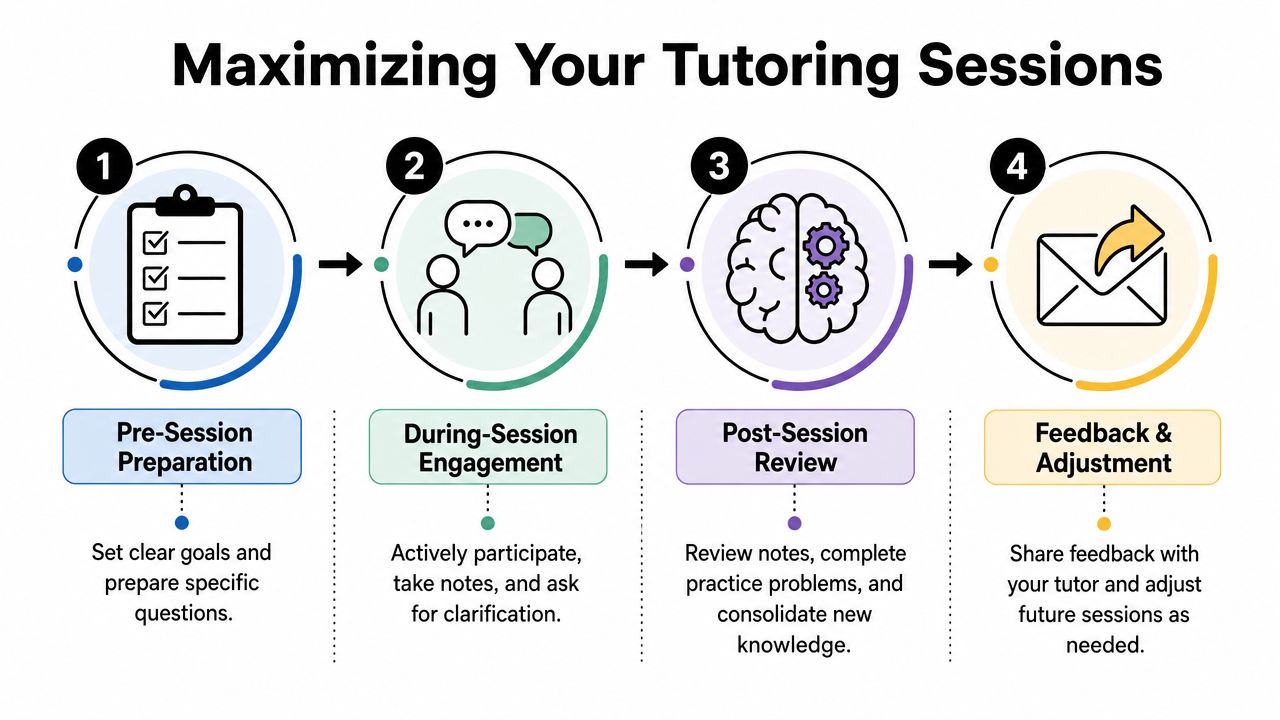
Once you've found the right tutor, your results depend on what you do with the time. Good tutoring is a partnership. You don't need to be perfect, but you do need to be active.
That matters even more if school was difficult for you first time round. Adults who left full-time education at age 16 or younger are much less likely to return to learning, at 34%, compared with 62% for those who left at 19 or older, according to the 2024 Adult Participation in Learning Survey from Learning and Work Institute. Confidence is not a side issue. It shapes whether people keep going.
Use this short routine to make each lesson work harder for you.
Before the session
Don't turn up and hope inspiration appears.
Do this instead:
- Pick one weak area: Such as moles, equilibrium, energetics, or organic mechanisms.
- Write two or three questions: Keep them specific.
- Bring evidence: A marked question, a page of notes, or a problem you couldn't solve.
This makes the lesson focused from the first minute. If you need help building stronger habits between lessons, these A Level revision techniques are a sensible place to start.
During the session
Be involved. Chemistry sticks better when you say things out loud, try methods yourself, and stop the tutor when something doesn't land.
Ask them to:
- talk through the logic, not just the answer
- show one worked example
- then watch you try one yourself
Here's a helpful video to support that more active approach.
A useful session is not the one where the tutor sounds clever. It's the one where you understand more by the end.
After the session
Many learners lose momentum when they finish the lesson, feel better, then leave the topic untouched until next week.
Do three simple things after every session:
- Review your notes within a day.
- Redo at least one question without help.
- Send a short message if something still feels unclear.
That final step is important. A good tutor should be able to adjust. If sessions move too fast, say so. If you need more exam questions, ask. If evenings are too draining, try mornings or weekends.
Small adjustments keep you on track. Silence doesn't.
Your Next Step to A Level Success
You do not need to become a different person to succeed at A Level Chemistry. You need the right support, the right routine, and the willingness to keep showing up.
That's why choosing an online A Level Chemistry tutor matters so much. The wrong tutor leaves you overwhelmed, out of pocket, and doubting yourself. The right tutor helps you build understanding week by week. They steady you when confidence dips. They help you study with purpose, not panic.
What matters most
If you remember only a few things, remember these:
- Choose support, not just convenience: A tutor should fit your life and your learning style.
- Check for adult learner understanding: Patience and empathy matter.
- Ask about exam boards and practical work: Chemistry success depends on detail.
- Use trial lessons properly: You are choosing a partner, not just buying an hour.
- Play your part: Preparation and follow-up turn tutoring into progress.
You are doing something brave. Plenty of adults think about returning to education. Far fewer take the first step. If you're reading this and searching for help, you've already started.
This can change more than your grades
A Level Chemistry can be a route into university courses and careers that once felt out of reach. It can help you move towards medicine, healthcare, science, engineering, or a completely new professional path. It can also do something quieter but just as important. It can rebuild your trust in yourself.
Your children don't need to see a perfect parent. They need to see one who grows.
If you want a better future, don't wait for confidence to arrive before you begin. Start, and let confidence catch up.
If you want flexible, fully supported study designed for adult learners, Next Level Online College is a strong place to begin. You'll find recognised online courses, expert teaching, and the kind of academic and pastoral support that helps real people succeed around work, family, and everyday life.