
Your First Step to a Future You Can Be Proud Of
Thinking about which GCSEs to take can feel overwhelming, especially if it's been a while since you were in a classroom. You might be asking what are the easiest GCSEs, and whether you can really do this after years of work, family life, and putting everyone else first. You can.
This isn't about taking the lazy option. It's about choosing the smartest route for your life now. The right subject can rebuild your confidence, fit around your responsibilities, and help you prove to yourself, and your children, that your story is still growing.
A good GCSE choice can do more than get you a certificate. It can help you move towards university, a better-paid job, or a career that feels meaningful. It can show your family what resilience looks like. It can turn self-doubt into pride.
Some subjects feel easier because they reward practical work, clear writing, steady effort, or life experience instead of heavy formulae and intense memorisation. That matters for adults. You already bring discipline, perspective, and real-world knowledge to your studies.
Below are eight GCSE subjects that many adult learners find approachable, useful, and confidence-boosting. Some are practical. Some reward thoughtful writing. Some connect closely to everyday life and work. If you choose well, your strengths can become your advantage.
1. Physical Education (PE) – Build Confidence Through Movement and Practical Skills
PE is often a strong choice if you learn best by doing, not just by reading. It combines movement, health, fitness, and theory in a way that feels real and active. If sitting with dense textbooks makes you switch off, PE can feel much more manageable.
For adults, this subject can be especially motivating because progress is personal. You don't need to be an elite athlete. You need to show effort, understanding, and improvement. That's a powerful message if your confidence has taken a knock.
The results picture is also encouraging. Physical Education had a pass rate of 70% in the 2025 analysis cited by Save My Exams, although it still sits below the strongest-performing language subjects for overall pass rates and top grades (Save My Exams on easiest GCSE subjects).
Why PE can work well for adults
If you already walk regularly, go to the gym, enjoy dance, play five-a-side, or follow sport closely, you're not starting from zero. You can connect theory topics like anatomy, nutrition, and training principles to things you already see in everyday life.
That makes revision less abstract. A football match can help you think about fitness demands. A gym session can help you remember muscle groups. A simple meal plan can bring sports nutrition to life.
Practical rule: Start with the activity you already enjoy. Confidence grows faster when the first win feels familiar.
- Build from your own baseline: Improvement matters more than looking sporty.
- Keep simple evidence: A notebook of sessions, goals, and reflections helps you track progress clearly.
- Use sport as revision: Watching athletes can help you spot biomechanics, tactics, and training methods.
If you've ever thought, “I'm not academic enough,” PE can challenge that belief in a healthy way. It rewards discipline, routine, and effort. Those are strengths many adults already have.
2. Art and Design – Express Yourself and Build Creative Confidence
Art and Design suits adults who want a subject with fewer rigid right-or-wrong answers. It values ideas, development, experimentation, and personal response. That can feel freeing if school once made you think you were “not clever”.
Many adult learners do well in art because they bring life experience to their work. They've felt pressure, joy, grief, responsibility, and change. Those experiences often lead to stronger themes and more meaningful creative choices.

What makes this subject feel more achievable
Art and Design rewards process. Your sketchbook, experiments, annotations, and development all matter. If your first piece isn't brilliant, that doesn't ruin everything. Showing how you improved is part of the strength of the subject.
That's good news for anyone rebuilding confidence. You're not expected to be perfect. You're expected to grow.
A simple example is a parent who chooses “home” or “identity” as a theme. Old family photos, fabrics, packaging, childhood memories, or local places can all become part of the project. That makes the work personal and easier to sustain when life gets busy.
Smart ways to make progress
- Choose a theme you care about: Real interest shows in the work and keeps you going.
- Document everything: Quick phone photos, notes, and rough sketches show your thinking.
- Practise timed work calmly: A quick mind-map before starting helps reduce panic.
Your sketchbook doesn't need to look neat. It needs to show that you thought, tested, changed, and improved.
Art can also be healing. After years of putting others first, making something with your own hands can remind you that your voice matters. That isn't a small thing. It can carry into work, study, and family life.
3. Religious Studies – Explore Meaning and Develop Critical Thinking
Religious Studies is one of the strongest choices for adults who like discussion, ideas, ethics, and real-life questions. You don't need to be religious to succeed. You need to think clearly, compare views, and explain your reasoning.
This subject often feels more natural for mature learners because adulthood gives you perspective. You've likely faced moral choices, family responsibilities, workplace challenges, and questions about fairness, suffering, or community. That helps.
The attainment data is striking. According to 2025 Ofqual data, Religious Studies had a Grade 9 attainment rate of 15.2%, the highest among non-core subjects, and 41% of students achieved Grade 7 or above, compared with 19% in Combined Science (Ofqual benchmark data summary).
Why adults often shine in this subject
Religious Studies rewards balanced argument. In a typical answer, you might explain one belief, compare it with another, then give a reasoned judgement. That's a skill many adults already use at work and at home when weighing up decisions.
Topics often include marriage, crime and punishment, peace and conflict, medical ethics, and human rights. These aren't distant ideas. They connect to everyday life, news stories, and values.
A thoughtful answer usually beats a memorised one.
Try building comparison tables for the religions you study. Keep two viewpoints for each ethical issue. Read news stories and ask yourself how different believers might respond. That small habit can make exam answers much easier to build.
Religious Studies is a strong subject if you want to prove to yourself that your life experience has academic value. It does.
4. English Language – Master Communication Skills That Change Your Life
English Language isn't just a school subject. It's the skill behind job applications, emails, interviews, reports, complaints, presentations, and everyday confidence. If you want a qualification that changes both your studies and your life, this is one of the most useful GCSEs you can take.
For adults, that practicality matters. You may already write messages to schools, speak to customers, read contracts, or explain problems at work. GCSE English takes those daily skills and sharpens them.
If English is one of the barriers between you and college, training, or university, studying GCSE English online with flexible support can give you a structured path without forcing your life to stop.
Why this subject can feel easier than you expect
English Language usually rewards clarity, structure, and thoughtful response more than specialist knowledge. You aren't trying to remember complex equations. You're learning how texts work and how to communicate effectively under timed conditions.
That doesn't mean it's effortless. It means the skills are useful and transferable. Every bit of practice helps somewhere else too.
A parent returning to study might practise persuasive writing by drafting a letter about a local issue. A care worker might use report-writing habits to improve precision. A retail supervisor might already understand tone, audience, and purpose better than they realise.
Simple ways to improve fast
- Read with a pencil: Underline words that shape tone, mood, or persuasion.
- Write for real purposes: Practise reviews, letters, articles, and descriptions.
- Read your work aloud: You'll hear awkward phrasing and missing words quickly.
English Language can be emotional for adult learners because it often carries old school memories. Don't let that history decide your future. Strong communication opens doors, and once this subject clicks, many learners feel taller in every part of life.
5. Food Preparation and Nutrition – Practical Skills That Feed Your Confidence
Want a GCSE that improves your daily life while you study? Food Preparation and Nutrition is one of the strongest choices for adults who learn best by doing, not just reading.
You can see progress quickly in this subject. Your knife skills get better. Your planning becomes sharper. You start making smarter choices about cost, nutrition, and time. That visible progress matters when you are rebuilding confidence after years away from education.
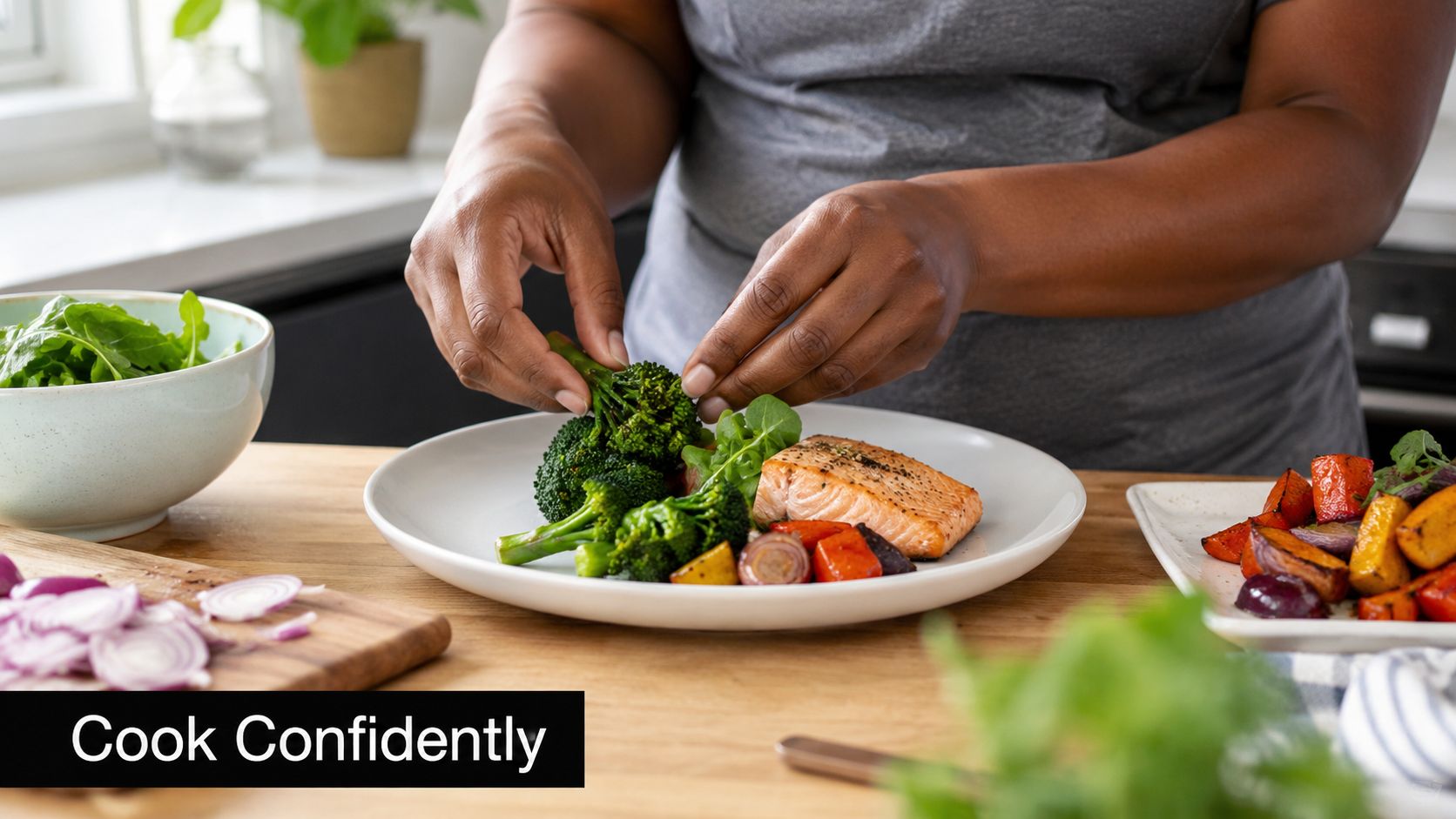
This subject does require steady effort. Practical subjects still expect accuracy, organisation, and subject knowledge. But many adult learners find it more approachable because the content connects to real responsibilities they already handle every week.
Why adults often do well here
If you have planned family meals, stretched a food budget, cooked after a long shift, or thought carefully about a child's diet, you already bring useful experience into the course. That life experience gives the theory a clear purpose.
You are not starting from zero. You are building on routines you already know.
That is a real advantage for adults who felt disconnected from school-style learning. Instead of asking, "When will I ever use this?", you can apply the knowledge straight away at home. Better still, if you later want to connect practical knowledge with work-focused study, Business courses and next-step study options can help you see how budgeting, planning, and decision-making skills carry into wider career progress.
What makes it feel manageable
Food Preparation and Nutrition rewards consistency more than flair. Adults often cope well with that because they are used to repetition, routines, and responsibility.
Try these habits:
- Cook with a purpose: Repeat the same recipe and improve one part each time, such as timing, presentation, or seasoning.
- Keep photo evidence organised: Clear photos help you review progress and stay in control of coursework or practical reflection.
- Learn the "why" behind the food: Nutrition facts stick better when you connect them to energy, health, child development, or medical needs in real life.
This short video gives a practical feel for food learning in action.
A subject that builds family pride as well as grades
This GCSE can change more than your study routine. It can improve how you shop, cook, plan, and care for the people around you. For many adults, that makes it easier to stay motivated because the reward is immediate.
You are not only working toward a qualification. You are proving to yourself, and often to your children or family, that learning can strengthen everyday life. That is powerful.
6. Business – Understand the Working World and Unlock Career Progression
Business is one of the most sensible GCSE choices for adults who want their studies to link directly to work. It covers topics such as marketing, finance, customer service, recruitment, and how organisations make decisions. If you've worked in any job at all, you already have examples in your head.
That's why Business often feels more accessible than very technical subjects. The ideas live in the world around us. You can see them in supermarkets, cafés, online shops, local trades, and your own workplace.
If you want a subject that can support progression beyond GCSE level, exploring Business courses and next-step study options can help you map a longer-term route into management, entrepreneurship, or higher education.
Real-life knowledge is your advantage
An adult who has worked shifts, spoken to customers, handled stock, or seen poor management already understands business problems better than a teenager who has only read about them. That doesn't replace study, but it gives the content context.
A simple example is pricing. If you've ever noticed why one shop offers discounts and another sells on quality, you're already thinking like a business student. If you've seen staff leave because morale was low, you understand human resources better than you think.
How to make Business feel straightforward
- Follow one company in the news: Watch what it changes and why.
- Compare options side by side: Sole trader, partnership, and limited company are easier to remember in a grid.
- Practise balanced answers: Most strong responses weigh benefits and drawbacks.
Best test of understanding: If you can explain a business idea to your child in simple words, you probably know it well enough for the exam.
Business can also shift your mindset. It helps you see how money moves, how jobs are created, and how decisions shape success. For many adult learners, that sparks ambition. A qualification can be the start of a better role, a promotion, or even your own venture one day.
7. Geography – Explore the World and Understand Global Challenges
Geography often sounds easy because it deals with the world around us. Weather, cities, rivers, resources, population, climate, and development all feel familiar. That can make the subject inviting for adults who want something broad and relevant.
Student perception supports that. A British Examinations ranking based on 2026 student feedback placed Geography as the easiest GCSE subject, ahead of Film Studies, Religious Studies, Media Studies, and Hospitality and Catering (student perception ranking of easy GCSE subjects).
Why perception isn't the whole story
Geography is interesting, but it does require organised case study knowledge and clear written explanation. That's why some adults enjoy it but still need a good revision system. If you like current affairs and don't mind learning examples, it can still be a smart option.
The subject becomes much easier when you link it to real events. Flooding in the news, heatwaves, regeneration projects, transport changes, and migration stories can all help fix concepts in your memory.
A delivery driver, carer, office worker, or parent already sees human and physical geography every day. Housing pressure, commuting patterns, local high streets, green spaces, and waste problems are all geographical issues.
How to stay on top of Geography
- Use short case study summaries: Keep each example to the key facts and why it matters.
- Sketch processes often: Water cycle steps, river features, and coastal change stick better when drawn.
- Read the news weekly: Current examples make longer answers stronger.
Geography can be a strong fit if you're curious about the world and want a subject that feels modern and relevant. It helps you understand not just places, but the forces shaping jobs, communities, and the future your children will grow up in.
8. Information and Communication Technology (ICT) – Digital Skills for the Modern Workplace
ICT is one of the most practical GCSE choices for adults who want skills they can use immediately. Spreadsheets, databases, presentations, file management, and digital problem-solving are useful in offices, schools, healthcare, retail, admin, and self-employment.
That direct job value makes the subject feel worthwhile from day one. You're not learning something distant. You're building competence employers recognise.
Adult learners often do well here because they're motivated by purpose. If a spreadsheet helps with budgeting, stock, rotas, or invoices, the learning sticks faster. If a presentation skill helps at work, confidence rises quickly.

The wider pattern for adult learners also matters. Department for Education-based market analysis reported that subjects like Drama and Film Studies showed 34% higher enrolment growth in the adult sector, with flexible assessment and lower exam weighting linked to stronger adult completion patterns (adult learner take-up analysis for practical subjects). ICT appeals for similar reasons. It tends to feel concrete, useful, and less abstract than formula-heavy subjects.
Why ICT can open doors fast
A learner returning to education might build a spreadsheet for household spending, create a presentation for work, or organise customer information more efficiently. Those are real wins. They prove that study isn't separate from life. It improves life.
If ICT gives you confidence with digital tools, it can also support progression into more advanced computing pathways. For learners who want to keep building, A Level Computer Science options for future progression can show what comes next.
Good habits that make ICT easier
- Practise with your own data: Household budgets and work-style examples make software skills stick.
- Explain your choices: Why a spreadsheet works better than a database matters.
- Save drafts carefully: Organisation is part of digital competence.
ICT is especially powerful if you've ever felt left behind by technology. Learning these skills proves that you can catch up, keep growing, and stay relevant in a changing job market. That can be a huge confidence boost.
Quick Comparison of 8 Easiest GCSEs
| Subject | 🔄 Implementation complexity | ⚡ Resource requirements | 📊 Expected outcomes | 💡 Ideal use cases | ⭐ Key advantages |
|---|---|---|---|---|---|
| Physical Education (PE) | Moderate, mix of practical assessments and written exams requiring regular sessions | Sports facilities, equipment and tutor-led practical time | Confidence through measurable physical progress; pathway into fitness, coaching or youth work | Hands-on learners, adults returning to study, those rebuilding confidence | Practical assessment, wellbeing benefits, visible progress |
| Art and Design | Moderate–high, sustained portfolio work plus a timed creative exam | Art materials, workspace/studio and ongoing tutor feedback | Portfolio showcasing creative development; routes into creative industries or freelance work | Visual/kinaesthetic learners, therapeutic learning, portfolio-building learners | Encourages originality, tangible progress and transferable creative skills |
| Religious Studies | Low–moderate, two full written papers demanding structured answers | Minimal, texts, notes and discussion time; no practical resources | Improved critical thinking, ethical reasoning and communication skills | Reflective adults, those interested in ethics, law, education or community work | Rewards life experience, promotes reasoned argument and respectful engagement |
| English Language | Moderate, two substantial written papers plus speaking endorsement | Reading materials, writing practice and tutor feedback | Stronger reading/writing skills, workplace communication and exam-ready literacy | Job-seekers, workplace communicators, adults wanting practical literacy | Directly transferable everyday skills and rapid visible improvement |
| Food Preparation & Nutrition | Moderate, coursework plus a sizeable written exam and minimum practical hours | Kitchen access, ingredients and documentation (photos/notes) | Practical cooking competence, nutrition knowledge; careers in hospitality/nutrition | Learners wanting life skills, catering pathways or family health improvement | Coursework reduces exam pressure; produces immediate, tangible results |
| Business | Moderate, two exam papers covering broad applied topics | Case study materials, revision time and basic financial calculations | Business literacy, analytical decision-making; supports entrepreneurship and promotion | Working adults, aspiring managers, prospective entrepreneurs | Real-world relevance, applies workplace experience and news |
| Geography | High, three exam papers plus fieldwork component and data interpretation | Fieldwork access, maps, case studies and data-practice resources | Evidence-based analysis of physical and human systems; environmental career routes | Those interested in environment, planning, policy or global issues | Connects to current events, engaging fieldwork and applied analysis |
| ICT | Moderate, coursework-heavy projects plus a practical/written exam | Reliable computers, common software (spreadsheets, databases, web tools) | Practical digital products and portfolio; immediate workplace applicability | Career changers, job-seekers needing digital competence, workplace upskilling | Continuous coursework, demonstrable portfolio and high employability |
Ready to Take Your Next Step and Change Your Life?
Choosing an easy GCSE isn't about lowering your standards. It's about choosing a subject that fits your strengths, your routine, and the future you want to build. This approach helps determine what makes a GCSE easy. The easiest one for you is the one that matches how you learn best and gives you the confidence to keep going.
If you prefer practical tasks, subjects like PE, Food Preparation and Nutrition, and ICT can feel far more manageable than heavily exam-based options. If you're stronger with ideas, discussion, and writing, Religious Studies, English Language, and Business may suit you better. If creativity or curiosity motivates you, Art and Design or Geography could be the subject that keeps you engaged long enough to succeed.
The biggest mistake adult learners make is assuming they're “too old”, “too rusty”, or “not academic”. That isn't true. Adult learners often bring stronger focus, better time awareness, and more determination than they had at school. You've handled responsibility, pressure, and setbacks already. Those experiences can become academic strengths.
And this matters for more than grades. A GCSE can help you move into higher study, apply for university, change career, or qualify for a role with better pay and more stability. It can help you show your children that learning doesn't stop when life gets busy. It can help you become the person in your family who proved that change is possible.
There's also something personal about finishing a qualification as an adult. It tells you that old labels don't own you anymore. You're not the person who struggled years ago, walked away, or doubted themselves. You're the person who came back.
Start with the subject that feels achievable and useful. Build one win at a time. Confidence doesn't arrive first. It grows because you act.
Next Level Online College supports adult learners who are juggling work, family, bills, and real life. Flexible online study, supportive tutors, and clear guidance can make the journey feel possible, even if you've been out of education for years. You don't need the perfect moment to begin. You need a decision.
Your family can be proud of what you do next. Above all, you can be proud of yourself. That certificate may look like paper, but it can represent something much bigger. A fresh start, a stronger future, and proof that you didn't give up on yourself.
Next Level Online College helps adult learners across the UK gain recognised qualifications in a flexible, supportive way. If you're ready to build confidence, improve your career options, and make your family proud, explore the courses at Next Level Online College.