
You might be sitting at the kitchen table after a long day, phone charging beside you, thinking you've left education too long to start again now. The kids are finally asleep, the forms still feel intimidating, and part of you wonders if Functional Skills Level 1 is really for someone like you.
It is. This qualification exists for adults who want a proper starting point, not for people who already feel confident. It's for the parent who wants to help with homework without guessing, the worker who wants better chances, and the adult who wants to show their children that learning doesn't end when school does.
You Are Not Alone and You Can Do This
The first hurdle is usually not the work itself. It's the feeling that everyone else has moved on and you've somehow been left behind. That feeling is common, and it's also misleading, because Functional Skills Level 1 is designed for practical progress, not for proving you already know everything.
A learner might open a laptop after a shift, glance at an enrolment page, and close it again because the words feel too formal. Then they look at their child struggling with spelling or a bill that doesn't quite make sense, and the reason to try again becomes clearer. Learning starts to feel less like a test of intelligence and more like a way to make everyday life easier.
A starting point, not a judgement
This qualification sits on a ladder. It gives you a real step up without expecting you to jump straight to the top. That matters if you've been out of education for years, because confidence often needs rebuilding before progress can really stick.
Practical rule: if you can already manage everyday tasks like reading short messages, adding up costs, or asking a simple question at work, you're closer than you think.
What makes this route powerful is the emotional side as much as the academic one. Passing a qualification can change how you speak about yourself, and that shift often spills into family life too. Children notice when a parent starts saying, “I'm studying,” instead of “I was never good at school.”
You do not need to feel ready before you begin. You only need to be willing to take the first small step and let the course meet you where you are.
What Functional Skills Level 1 Actually Is
Functional Skills Level 1 is a government-backed qualification in practical English and maths, and it's built for real life rather than theory-heavy study. Think of it as a toolkit, not a textbook. You're not learning for the sake of abstract exercises, you're learning so you can read, write, calculate and communicate more confidently in daily situations.
It also sits within a wider ladder of learning. Below Level 1 are the Entry Levels, which focus on the earliest building blocks. Above it is Level 2, which is the next big step and usually the target for stronger job and study progression.
The qualification is available in English, Mathematics and Digital Skills at Level 1 through providers such as City & Guilds' Functional Skills offer, which shows that it's not just one narrow course but part of a broader progression route for adults (City & Guilds Functional Skills).
A simple way to picture it
If GCSEs are like a full-length film, Functional Skills Level 1 is more like a focused skills workshop. You still leave with something real, but the aim is practical use, not academic performance for its own sake. That's why many adults find it easier to connect with their day-to-day life.
Functional Skills Level 1 English and maths are often described as sitting around the same general standard as a lower GCSE level, but the more useful point is this, they're respected qualifications that show you can handle everyday tasks. They help you prove you can work things out, explain yourself clearly and use numbers with purpose.
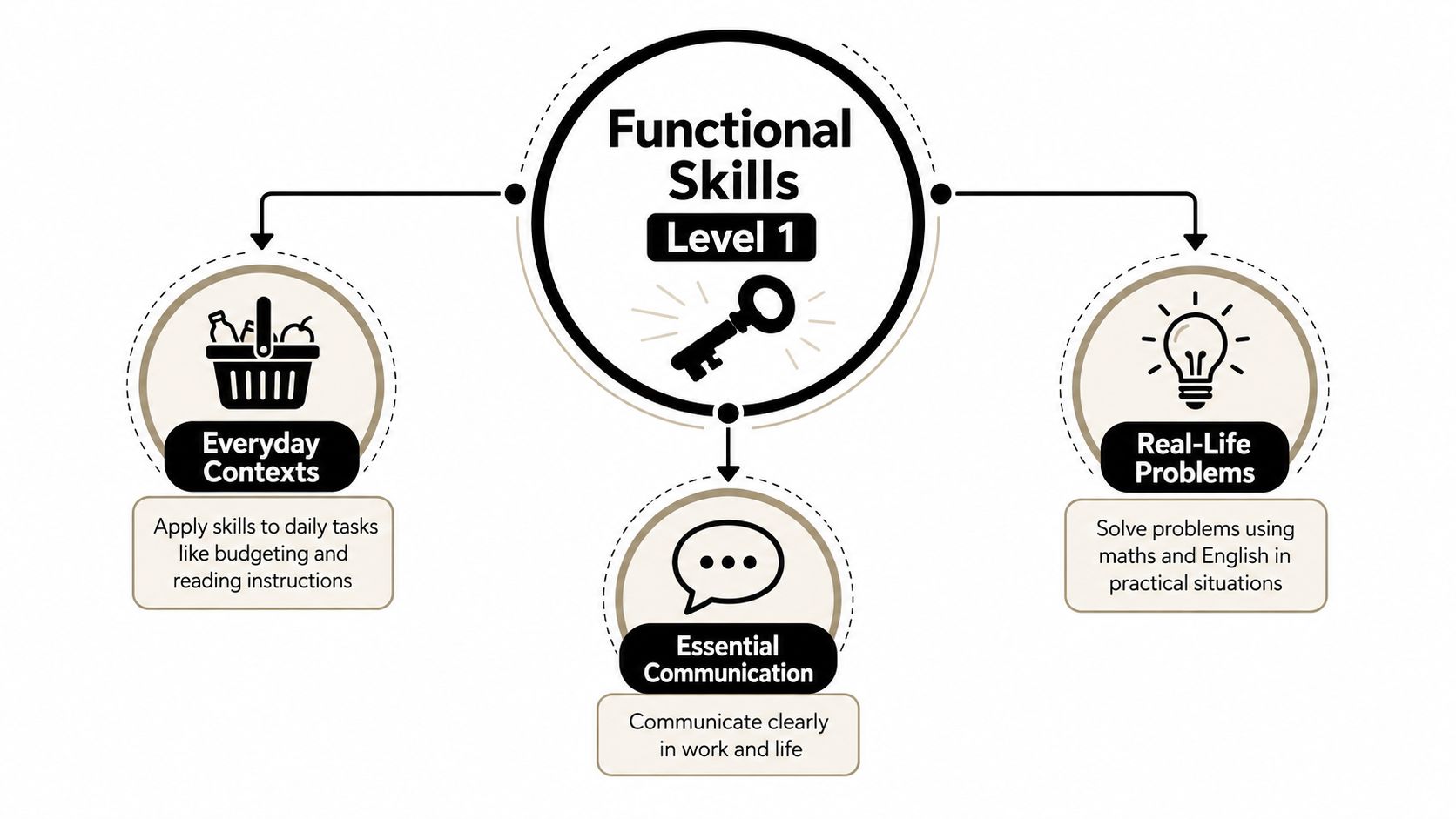
By the end of Level 1, you should be able to say, in plain English, that it's a practical qualification that helps with work, home and further learning. That description is accurate, and it's enough.
What You Will Learn in English and Maths
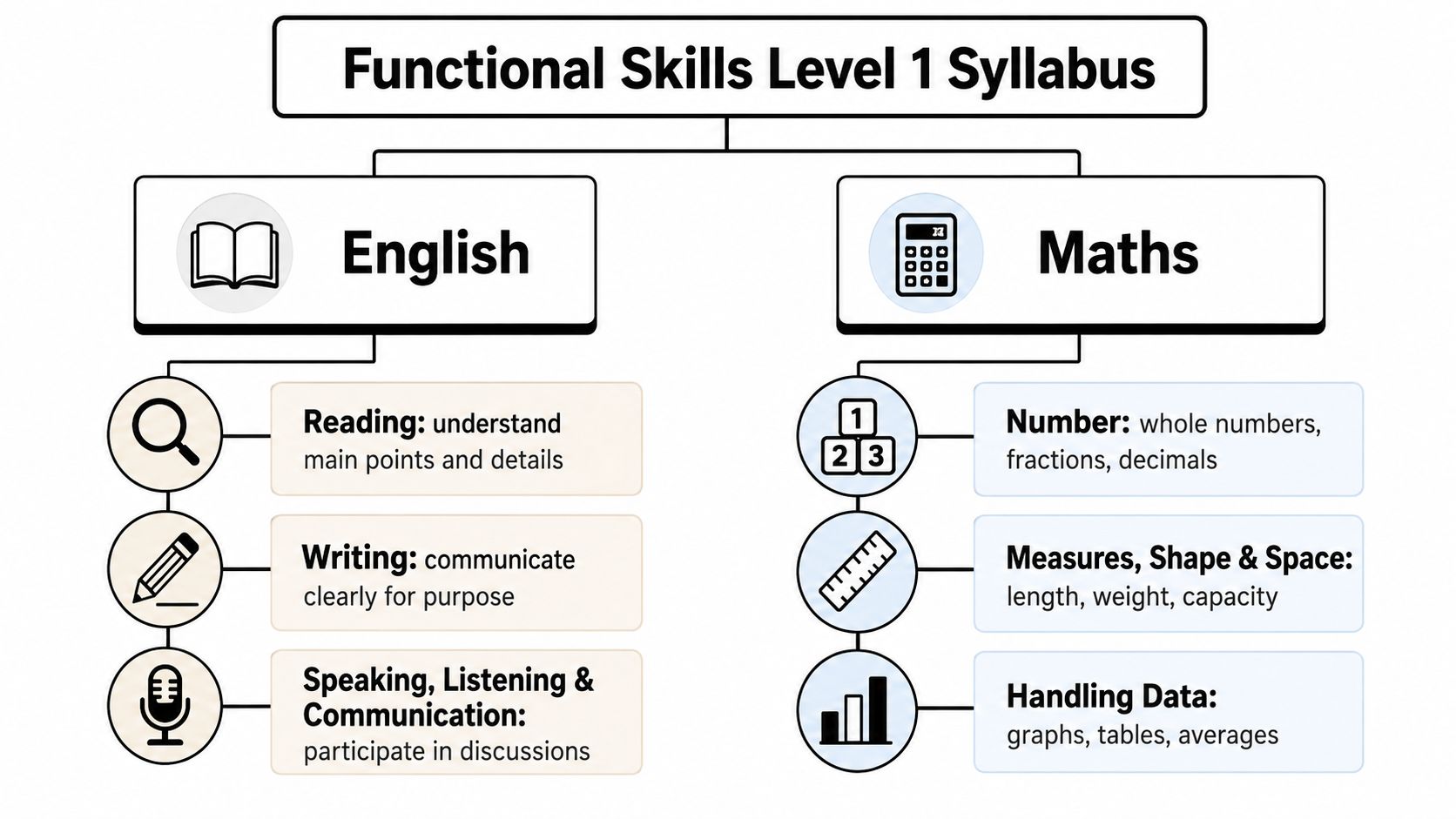
A useful way to approach Level 1 is to split it into English and maths, then look at what each subject asks you to do in real life. The work is practical, and many adults already use parts of it every day without giving themselves credit for it.
English for everyday use
Functional Skills English Level 1 focuses on reading, writing and speaking in real situations. The qualification checks the full range of communication skills, so you are not only being tested on written work, as shown in the official NCFE Level 1 Functional Skills English assessment structure. Learners need to pass all three components at the same level to gain the qualification, and the Writing component carries 40 to 45% of the weight at Levels 1 and 2.
In plain language, that could mean reading a short notice, writing a clear message, or taking part in a simple discussion. It is the sort of English you use for a form, a workplace request, or a brief email when you need to stay calm and get the point across.
If you want a fuller explanation of the content and expectations, the guide to Functional Skills English Level 1 is a helpful companion to your notes.
Maths that feels useful, not random
Functional Skills Mathematics Level 1 is built around the three process skills of Representing, Analysing and Interpreting. In practical terms, that means working with numbers up to one million, using positive and negative numbers, and multiplying or dividing whole numbers and decimals by 10, 100 and 1,000.
You will also meet everyday number work such as fractions, decimals, percentages, simple interest, charts and probability. That is why this level feels closer to handling real life than solving school-style puzzles. The overall qualification is set at 61 total qualification hours with 55 guided learning hours, and the assessment is externally assessed on demand with both non-calculator and calculator sections.
A good sign that you are ready to learn this material is that it already appears in your life. Money, measurements, messages, timetables and shopping all belong here.
Assessment structure is detailed in the next section.
How the Assessments Work and What to Expect
A lot of anxiety comes from not knowing the shape of the test. Once you can see the structure, the fear usually gets smaller. The assessments are not trying to catch you out, they are checking whether you can use skills in a sensible, practical way.
| Subject | Component | Format | Pass Requirement | Weighting |
|---|---|---|---|---|
| English | Reading | External assessment | Pass all three components at the same level | Part of the overall qualification |
| English | Writing | External assessment | Pass all three components at the same level | 40 to 45% |
| English | Speaking, Listening and Communicating | Controlled assessment | Pass all three components at the same level | Part of the overall qualification |
| Maths | Overall test | Single externally assessed on-demand test | Pass the test | Whole qualification |
For English, the main thing to remember is that you need to pass Reading, Writing, and Speaking, Listening and Communicating at the same level. That means the qualification rewards balanced communication, not just neat spelling or good reading on its own. See the earlier syllabus section for the full specification details.
The English tasks are meant to reflect everyday communication. A reading task might ask you to find key information in a short text, while a writing task might ask for a clear email, note, or short response for work or home. The speaking, listening and communicating part checks whether you can take part in a real exchange, listen properly, and give information clearly.
For maths, the shape is simpler. Pearson's Level 1 qualification uses a single externally assessed test, usually split between calculator and non-calculator work, so timed practice matters. AQA's guidance also shows the technical ceiling includes working with numbers up to one million, adding and subtracting up to one million, multiplying and dividing by integers 1 to 12 without a calculator, and using fractions, decimals, percentages, simple interest, charts and probability. See the earlier syllabus section for the full specification details.
A typical maths question might ask you to compare two bills, work out a quantity, or read a chart and draw a sensible conclusion. The question will usually feel more like a task from daily life than a puzzle from a textbook. If you know how to compare, estimate, and explain your answer, you are already practising the right habits.
For a clearer picture of the final stage, the Functional Skills test guide gives a useful overview of what the assessment process looks like.
Choosing How to Study That Fits Your Life
The right study route depends less on what sounds impressive and more on what you can keep going with. If you've got work, children, caring responsibilities, or all three, the best option is the one that fits your real week, not your ideal week.
Three common routes
A local college gives you structure, face-to-face support and a set timetable. That can suit learners who like being in a classroom and want the rhythm of weekly attendance.
A fully supported online course gives you more flexibility. You can fit lessons around shifts, school runs and family life, which is why many adults return to learning this way. Strong support usually means access to a tutor, feedback on work, and pastoral help when confidence dips, not just a pile of videos to watch alone. One provider option in this space is Next Level Online College, which offers online Functional Skills courses alongside tutor and wellbeing support for adult learners.
Self-study can work if you're already disciplined and comfortable finding your own resources. It's the most flexible route, but it also demands the most self-motivation, and many adults find that hard after a long break from education.
Practical rule: choose the route that gives you enough support for the weeks when life gets messy, not just the weeks when everything runs smoothly.
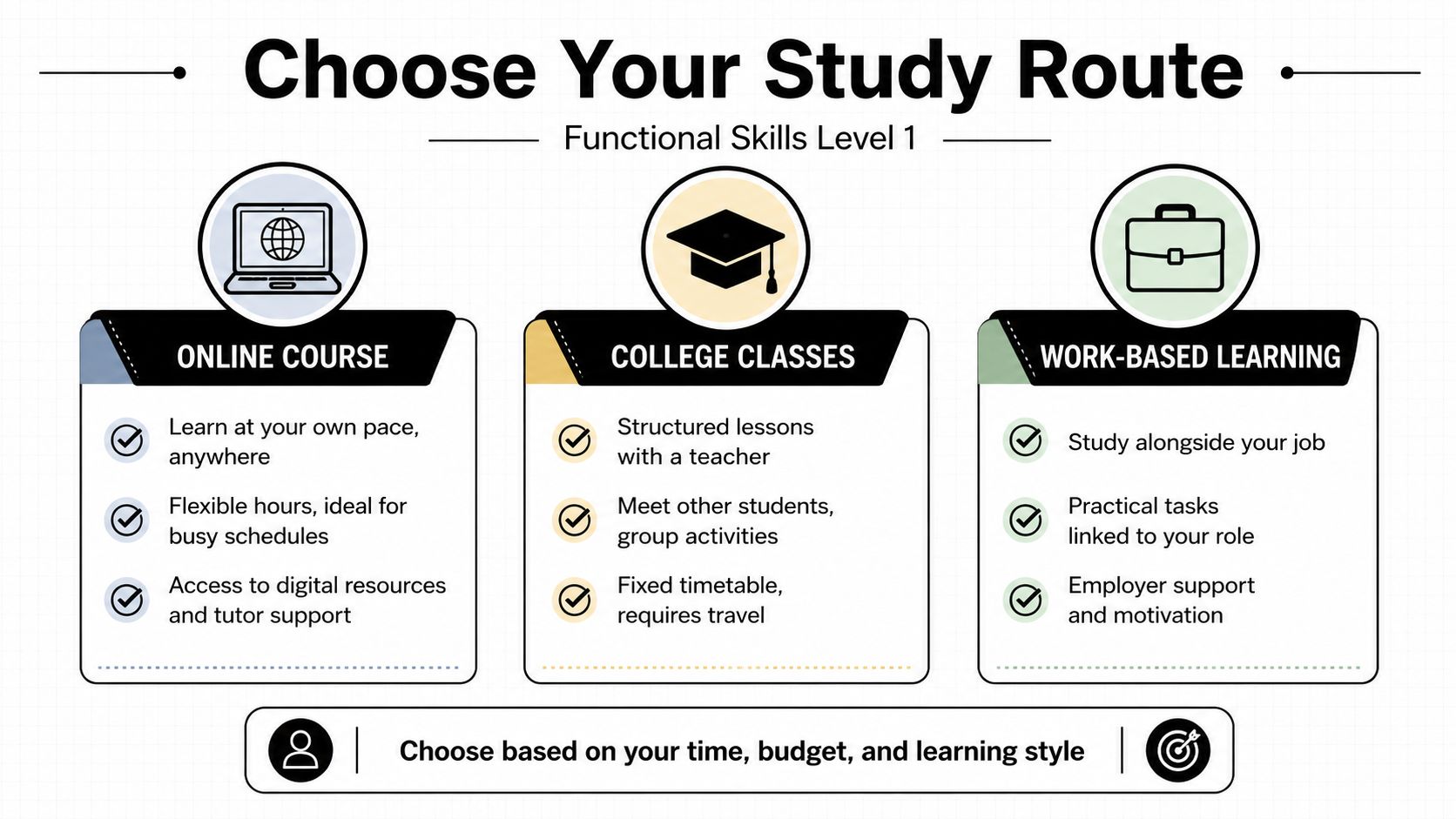
If you need quiet, flexibility and a chance to study after the house is calm, online learning often makes the most sense. If you learn better by asking questions in the room, a college class may suit you more. If you're studying around a job, then the steady link between your course and your work routine can make the effort feel more immediate.
The best route is the one that keeps you moving. Progress matters more than perfection.
Timelines, Funding and How to Get Started
Adult learners commonly ask about timelines and funding before they enrol. Those are practical questions, because fitting study around work, family and everything else takes planning.
Part-time learners often complete Level 1 in about 8 to 16 weeks, although the pace depends on the provider, the number of study hours and how often you can revise. Analysts using the explore education statistics dataset show that Level 1 Maths is a substantial qualification route in its own right, with outcomes recorded across different provider types, including FE and ACL settings.
Funding and entry basics
Many adults can study Functional Skills for free if they do not already hold a GCSE grade 4 or equivalent in that subject. In some cases, an Advanced Learner Loan may apply, and employers sometimes fund upskilling when the qualification supports the role. Entry is usually open, which helps if you have been out of school for years or left formal study without strong results.
Some learners begin even earlier on the pathway. Government FE data for 2023/24 shows 405 entries for Functional Skills English Entry 1 in FE sector colleges in England, with a pass proportion of 5.075%. That shows the route includes true beginners as well as people moving on towards Level 1 and beyond.
- Check your subject and current level. Decide whether you need English, maths, or both.
- Ask about funding. Confirm whether you qualify for free study, employer support, or an Advanced Learner Loan.
- Choose your course format. Pick college, online support, or self-study based on your weekly routine.
- Collect your ID and enrol. Most providers ask for basic personal details, not a long list of previous grades.
- Build a first study week. Put the first sessions in your diary before life gets in the way.
If you like planning before you start, a simple template can help. This study planner template resource is a practical place to begin.
Where Level 1 Can Take You Next
Level 1 is not the end of the road. It's the point where many adults finally stop avoiding maths or English and start building a route they can follow.
The next step for many learners is Level 2 Functional Skills, which sits closer to a GCSE grade 4 standard and is often the qualification employers and education providers look for when they want stronger evidence of literacy and numeracy. That matters because people often discover that a Level 1 pass gives them confidence, but not always the full entry profile they need for the next move.
A wider map for adults
Some learners stay on the Functional Skills path and continue to Level 2. Others choose GCSE resits if they need that route for a specific application. Adults aiming for university may also use Access to HE diplomas, which are common stepping stones into higher education for returners who need a structured bridge.
The subject matter in Functional Skills also links to real employment needs. Roles in healthcare, teaching, the police and the civil service often value secure English and maths, because routine communication and accurate number handling matter in those settings. That's where Level 1 starts to feel like the first part of a longer professional journey, not just a qualification on paper.
For some adults, the long-term goal is university. Functional Skills can support that aim, but different universities set their own entry rules, so checking the exact requirements for the course you want is still important. The key point is that Level 1 can help rebuild the habit of learning, which makes later steps less frightening.
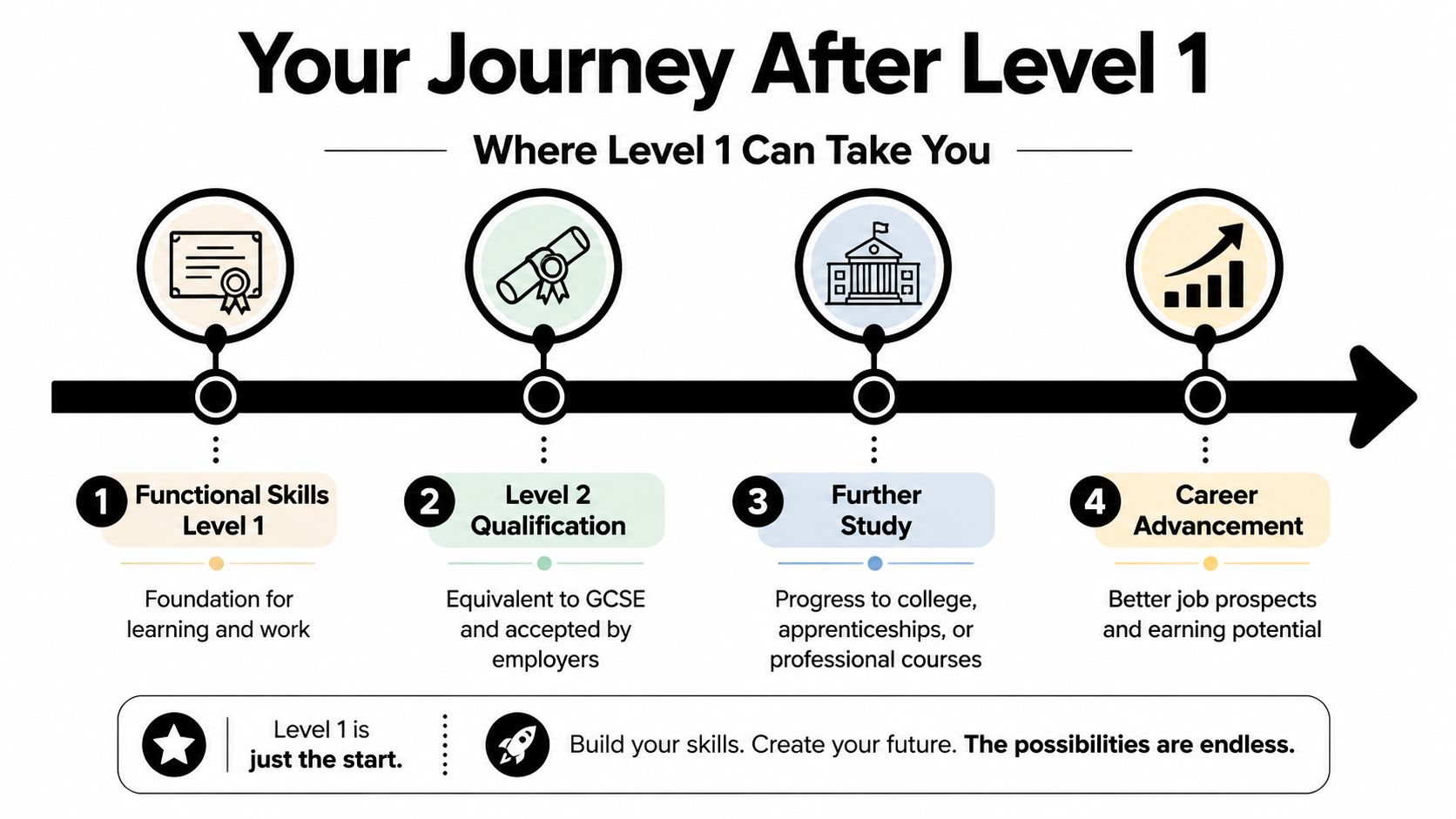
If you've been away from education for a long time, that long view matters. A single pass can become the first visible proof that you're capable of more, and that proof changes the next decision.
A Practical Plan to Prepare and Pass
The easiest way to get stuck is to revise everything at once. A calmer plan works better, especially if you're juggling work, children or tired evenings. Start small, keep it regular and make sure each session has a purpose.
A simple weekly rhythm
For the first two weeks, focus on getting used to the course layout and spotting weak areas. Spend roughly half your time on English and half on maths if both subjects are on your list, then shift slightly towards whichever one feels less secure. In week three and four, move into timed practice, because that's when you begin to notice whether you can finish tasks without panic.
By the final stretch, spend more time on exam-style questions than on reading notes. That's the point where revision becomes performance practice, and it helps you feel less surprised on the day.
Keep this checklist near you
- Know your weak spots: Identify the topics that slow you down, then return to them often.
- Practise timing: Work with a clock so the test doesn't feel rushed.
- Check speaking tasks: Don't ignore the English speaking, listening and communicating part.
- Use calculator and non-calculator practice: Both matter in maths.
- Review mistakes properly: Don't just mark answers, understand why they went wrong.
Common mistakes are usually simple. People revise only the easiest topics, forget the speaking component, or spend all their time on calculator work and then struggle when they need to do mental maths. A supportive course helps because a tutor can spot those gaps before they turn into exam-day stress.
If you want a course that fits around family life and still gives you structure, online support can make a real difference. You're not trying to become a different person. You're building on the person you already are, one sensible step at a time.
Keep going for the version of you that can walk into the room a little taller, help at home a little more easily, and show your children that starting again is possible.
If you're ready to take that first step, Next Level Online College offers flexible online Functional Skills courses with support designed for adult learners who need English, maths, or both. Visit Next Level Online College to see how their courses can fit around work, family and the confidence you're building for the future.