
You're sitting at the kitchen table after the children have gone to bed, scrolling through your phone and wondering whether you've left it too late to study science. Perhaps you need Biology for a new career, a university application or a promotion. Perhaps you want to prove to yourself, and to your family, that you can do something you once thought was out of reach.
GCSE Biology online can make that goal fit around real life. You can study before an early shift, during a quiet lunch break or after the school run, without travelling to a college every day. The qualification still requires serious preparation, but online learning can give you a clearer route back into education.
Why More Adults Are Choosing GCSE Biology Online
A GCSE is a Level 2 academic qualification, broadly equivalent to the standard school qualification. Biology is a separate GCSE option with value in health, science and education pathways. It can support applications for nursing, midwifery, teaching, paramedic science and other further-study routes, although each university or employer sets its own entry requirements.
The subject remains large in the UK education system. Provisional summer 2025 GCSE Biology entries were 171,690 in England and 183,539 across the UK, while Ofqual's provisional summer 2026 figure for England was 169,915, showing that Biology continues to matter to many learners. These figures are reported in Ofqual's provisional GCSE entries data.
Online study removes one of the biggest problems for an adult learner: fixed classroom times. You might watch a lesson at 6am before work, read a module while the children are at school or complete practice questions at 10pm after homework and housework. That flexibility doesn't remove the work, but it lets you choose when the work happens.
You're part of a wider return to learning
Adults return to education for many reasons. Some want a qualification they didn't achieve at school. Others need Biology before applying for a health course or changing direction at work. Cambridge Assessment data records Biology entries rising from 55,643 in 2002 to 178,766 in 2013, then to 183,539 in 2025, with Year 11 learners making up around 96% of 2025 entries and Year 12 and older learners making up 3.1%. The historical and current figures are discussed in Cambridge Assessment's GCSE subject uptake information.
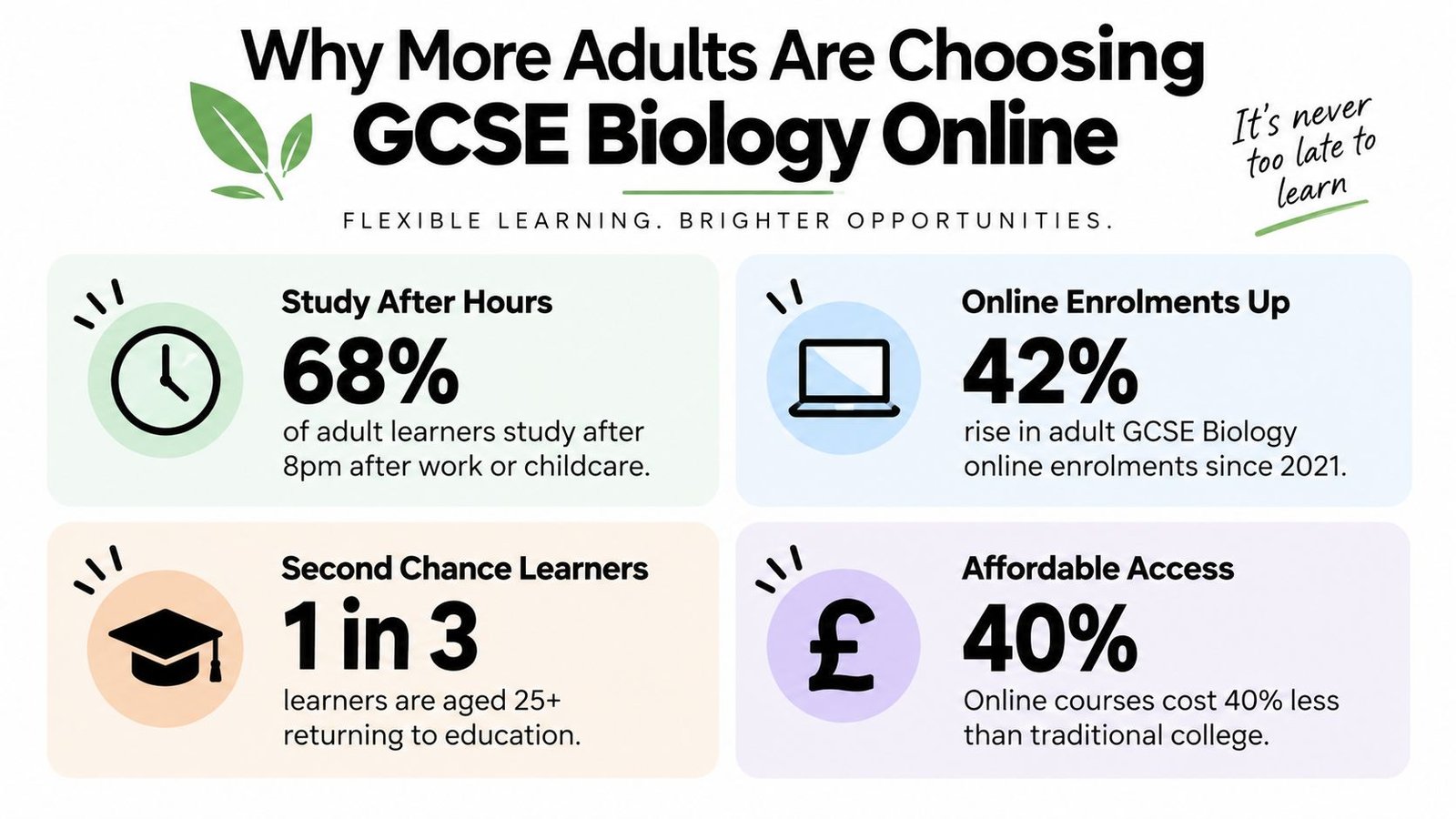
That small older-age group in the entry data doesn't mean adult learning is unusual. It means many adults are taking a different route from the usual school timetable. You may feel nervous because you haven't revised for years, but you don't need to remember everything today. You need a manageable plan, helpful explanations and the courage to begin.
What You Will Actually Learn in GCSE Biology
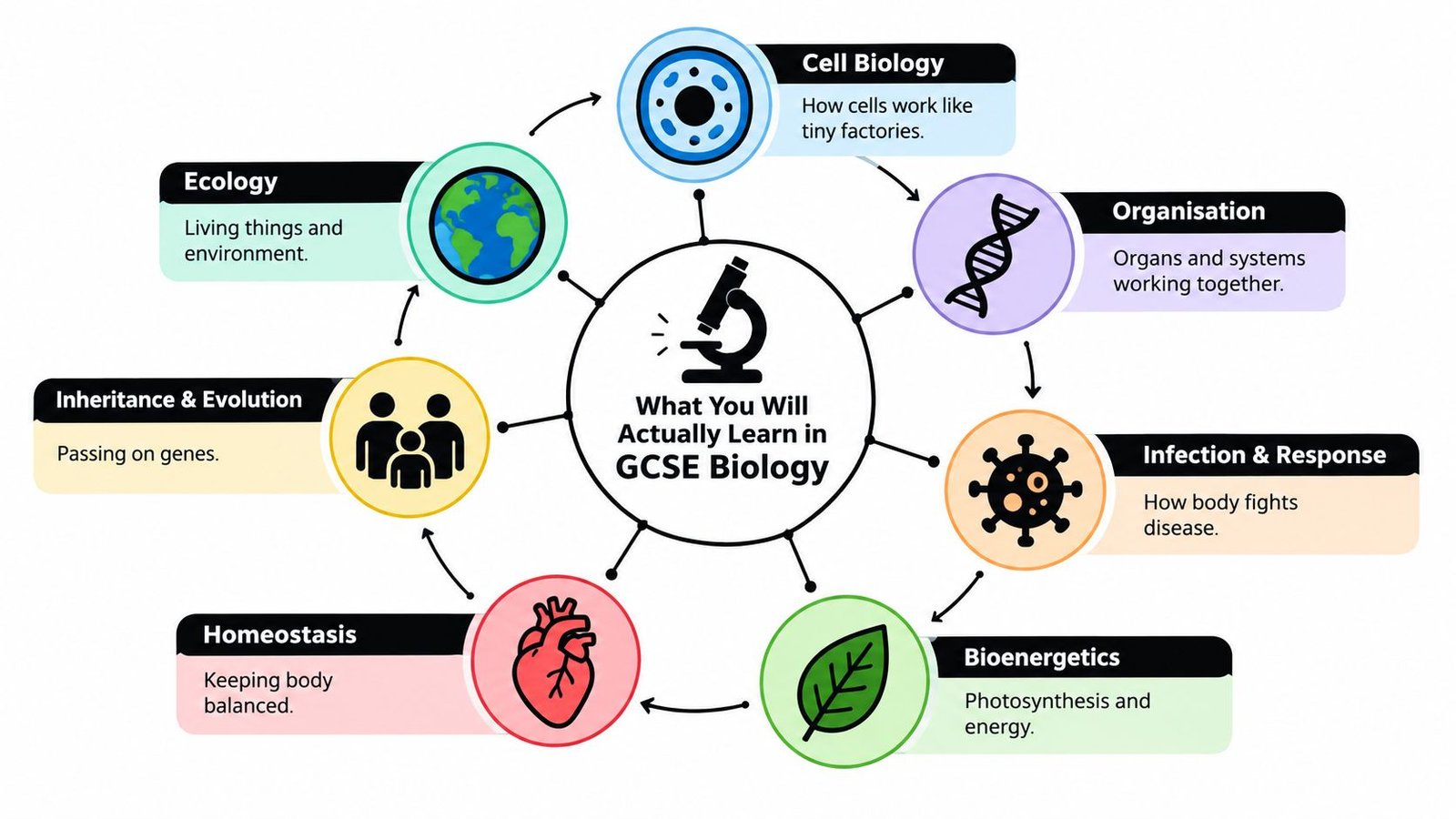
GCSE Biology is easier to understand when you see it as a story that starts with tiny parts and gradually builds towards whole environments. The exact order can vary between AQA, OCR and Edexcel, so always follow the specification attached to your course.
Start small, then build upwards
Cell Biology comes first in many courses. Think of a cell as a tiny factory. The nucleus acts like the manager's office, the cell membrane controls what enters and leaves, and mitochondria release energy for the cell's work. Once you understand what the parts do, topics such as cell division and movement of substances become less frightening.
Organisation then moves from small parts to larger systems. Cells with similar jobs form tissues, tissues form organs and organs work together in systems. A useful comparison is a well-run office. One worker can't run the whole organisation, but different teams can cooperate to keep everything working.
Infection and Response treats the body like a defended house. Pathogens are unwanted visitors, while barriers, white blood cells, antibodies and medicines help protect the body. This topic also links naturally to everyday experiences, such as vaccinations and why antibiotics don't treat viral infections.
Bioenergetics is about how living things obtain and use energy. Photosynthesis allows plants to make glucose, while respiration releases energy from food. Think of respiration as the body's engine and glucose as part of its fuel supply.
Connect the body, family and planet
Homeostasis and Response looks at how the body keeps its internal conditions stable. Your body regulates temperature, water levels and blood glucose much like a home thermostat keeps a room within a comfortable range.
Inheritance, Variation and Evolution explores how features pass between generations. DNA works like an instruction manual, and genes are sections of that manual. Changes in genes can create variation, while natural selection helps explain how populations change over time.
Ecology widens the view to living things and their surroundings. An ecosystem is like a balanced neighbourhood. Plants, animals, microorganisms and environmental factors all affect one another, so changing one part can influence the rest.
The content is the same kind of Biology studied by teenagers, but adult learners often bring useful experience. You already observe patterns, solve problems and make decisions. A focused learner can work towards a grade 4 or 5, provided the chosen course and tier match the goal.
Watch this short lesson for another way to approach the subject:
How the Exams Are Structured
Formal exams can feel intimidating after a long break from school, but the structure is fixed. In AQA GCSE Biology, the qualification is linear and assessed through two written papers. Each paper lasts 1 hour 45 minutes, carries 100 marks and contributes 50% of the GCSE. AQA's GCSE Biology specification explains the paper design and topic split.
Paper 1 covers cell biology, organisation, infection and response, and bioenergetics. Paper 2 covers homeostasis and response, inheritance, variation and evolution, and ecology. Questions can include multiple choice, structured questions, short answers and open responses.
Foundation or higher
The tier choice needs careful thought. Foundation is designed around grades 1 to 5, while Higher is designed around grades 4 to 9. GOV.UK explains that Foundation specifications assess the listed content except the underlined content, while Higher specifications assess all the listed content. Tier therefore changes the content you must prepare, not only the difficulty of the questions. See the GOV.UK GCSE biology subject content.
| Feature | Foundation Tier | Higher Tier |
|---|---|---|
| Grade range | Grades 1 to 5 | Grades 4 to 9 |
| Content | Listed content, except underlined content | All listed content |
| Best fit | A learner targeting a secure pass within the Foundation range | A learner needing access to grades above 5 |
| Main question | Is this enough for my next step? | Can I manage the wider content and higher demand? |
The assessment objectives are also useful. AO1 tests knowledge and understanding, AO2 tests applying knowledge to new situations, and AO3 tests analysing information and ideas. GOV.UK gives AO3 a stated 40% weighting in the conditions document, so don't prepare by memorising definitions alone.
AO2 and AO3 may sound academic, but adults use similar skills every day. You compare information at work, notice patterns, judge whether something makes sense and explain decisions. Those habits can become exam skills with practice.
For a wider route involving more than Biology alone, compare the Combined Science GCSE pathway, then check which qualification your intended college, university or employer accepts.
Studying GCSE Biology Online Around Real Life
A realistic online course should give you a clear route through lessons, practice and practical work. OCR Biology B states that learners must complete at least eight practical activities, and its qualification has 100% external assessment. OCR also lists a total qualification time of 140 hours, with guided learning time of 120 to 140 hours, as set out in the OCR Biology B specification.
Those figures help you plan. They don't mean you must study for long hours every day. They mean you should protect regular time across the course and ask the provider exactly how practical evidence will be completed.
A week that leaves room for family
Online lessons may include recorded videos, live tutorials, written modules, quizzes and tutor-marked work. Self-directed practice means answering questions without looking at your notes, checking your errors and returning to the part you haven't understood.
A working parent might use a rhythm like this:
- Before work: Read a short section or revise key words.
- During a lunch break: Complete a small quiz or label a diagram.
- After the school run: Watch a lesson while the house is quiet.
- At the weekend: Complete a longer activity, practical write-up or past-paper section.
Try 30-minute Pomodoro blocks. Study for 25 minutes, take a short break, then spend a few minutes writing what you can remember. Two focused blocks can be more useful than an exhausted evening spent staring at a textbook.
Practical work needs a proper answer
Don't accept a vague promise that practicals are “covered online”. Ask whether the provider sends equipment for home use, supplies video demonstrations with written records or arranges in-person workshops. OCR's requirement shows why this matters. Reading about an experiment isn't always the same as understanding variables, safety, method and results.
Keep one fixed weekly Biology slot in your calendar. Tell your family why it matters, prepare materials before you begin and keep a simple record of completed lessons. Guidance on building a sustainable routine is available in this time-management guide for students.
Where GCSE Biology Can Take You
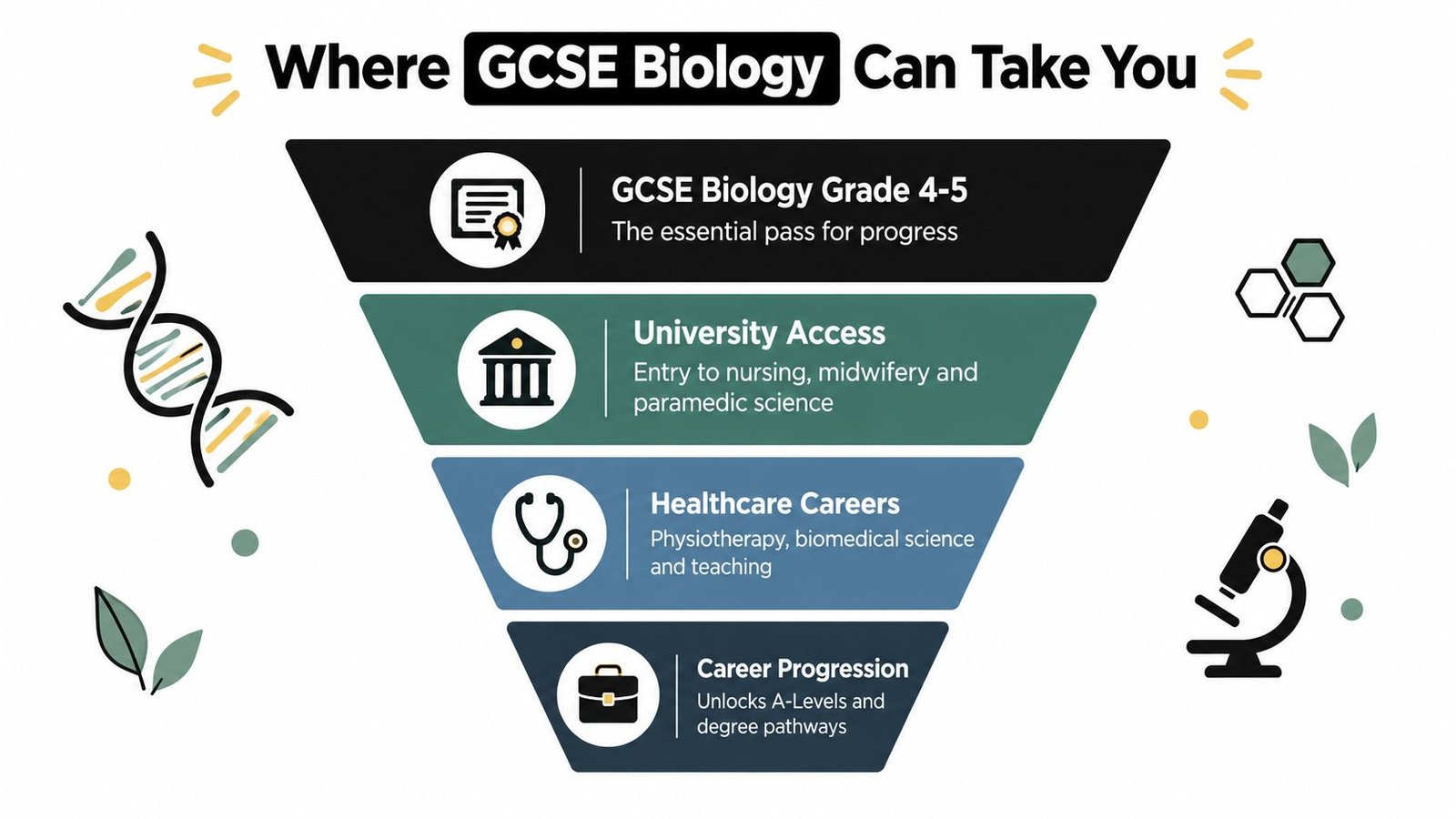
A Biology GCSE can be more than a certificate in a folder. For an adult learner, it can be the first clear step on a progression map:
GCSE Biology, then further study, then a new route.
The next stage might be an Access to Higher Education diploma, A levels or another college course. From there, learners may explore nursing, midwifery, paramedic science, physiotherapy, biomedical science, teaching, conservation, horticulture or veterinary nursing. Entry rules vary, so check each institution before choosing your grade target.
Progress at work
A science qualification may strengthen progression for people working as care workers, teaching assistants, pharmacy assistants or in other support roles. Some employers and apprenticeship providers ask for science qualifications or may value evidence that you can study, meet deadlines and handle technical information.
The right target depends on your destination. A grade 4 or 5 may meet one requirement, while another course may ask for a higher grade or a different combination of qualifications. Don't choose Foundation or Higher just because one sounds safer. Match the tier to the next step you want to take.
The family impact matters too
Your children may notice that you study after work, ask questions about cells or keep going after a difficult practice paper. You become a living example that education doesn't end when school ends. That example can help you rebuild confidence before applying for a bigger course.
The Department for Education's adult participation measures indicate that around one quarter of adults in England participated in learning in the previous 12 months, and participation tends to be higher among adults with higher qualifications. The figures are summarised in AQA's Biology GCSE specification information. Returning to study can therefore be part of a normal progression into further learning, not a sign that you've fallen behind.
Sorting Out the Exam Booking Side
The word “online” describes how you learn, not usually where you sit the final exam. Many online GCSE Biology providers require learners to book written exams separately through an approved centre, and private-candidate arrangements can be the part that surprises adults most. This guide to taking GCSEs online explains why online study and online examination aren't the same thing.
As a private candidate, you aren't entered through a school as a regular pupil. You normally contact an approved exam centre, often a secondary school or further-education college, and ask whether it accepts external candidates for your chosen awarding body.
A sensible booking checklist
- Confirm the specification. Check whether your course uses AQA, OCR or Pearson Edexcel, and write down the qualification code where available.
- Search locally. Look for centres close to home, work or a reliable travel route.
- Ask direct questions. Confirm the board, subject, tier, exam dates, access arrangements and total charges.
- Register as a private candidate. The centre will explain its forms, identity checks and payment process.
- Plan the day. Arrange childcare, work cover and travel before the examination timetable becomes urgent.
A centre might not offer every board or subject, so don't assume that the nearest school can enter you. Contact several possible centres and keep their replies in one folder.
Practical rule: Choose the course and exam centre together. A flexible study plan is only useful if you can reach the centre and sit the correct papers.
Adult learners also need to consider shifts, holidays and family responsibilities. Put the published exam dates into your calendar as soon as they're available. If a date clashes with a holiday, ask the centre what options exist. Don't wait until the final weeks, when choices may be limited.
Your First Steps and Common Questions
Start with the outcome, not the textbook. Write down the course, job or university pathway you want to reach, then check its Biology grade and awarding-body requirements. This prevents you from studying a qualification that doesn't match your next step.
A simple starting plan
- Check your starting point. You don't usually need to feel “ready” before asking about entry. Tell the provider what you studied before, how long you've been away and what support you need.
- Compare recognised courses. Check the awarding body, specification, tutor support, mock exams, practical arrangements and whether exam fees are included.
- Check the centre early. Find out where you'll sit the papers before paying for a course.
- Protect study time. Begin with a weekly slot you can keep, rather than promising yourself an unrealistic timetable.
- Use active practice. Read a section, close the book, explain it aloud and answer questions from memory.
Do I need previous Biology qualifications? Not necessarily. Providers can advise whether the course suits your starting point, and a short diagnostic activity can show where you need extra help.
How long will it take? It depends on your chosen specification, available study time and examination date. AQA says the qualification is designed to be taken over two years, while OCR states guided learning time of 120 to 140 hours for Biology B in its specification.
Can I sit exams near family abroad? You'll need to ask the awarding body and the prospective overseas centre whether it accepts private candidates for your exact qualification. Don't book travel until the centre confirms the arrangement.
How do I practise practical skills online? Ask whether your provider offers home equipment, demonstrations, write-up support or face-to-face sessions. The practical requirement must be part of your plan, not an afterthought.
You don't need a perfect study routine. You need the next small action. This week, download the correct syllabus, contact an exam centre or book a taster lesson. One completed action can turn a worrying idea into a real route towards confidence, family pride and a future career.
Next Level Online College offers flexible online GCSE courses, including an International GCSE in Biology using the Pearson Edexcel qualification code 4CH1, with structured learning and academic support for adult learners. Visit Next Level Online College to review the Biology route, check the course details and take your first practical step towards studying GCSE Biology online.