
It's 9 p.m. The children are finally asleep, the kitchen is quiet and your GCSE Psychology book is open beside a cup of tea that's gone cold. You read the same paragraph twice, but the words still don't seem to stay in your mind. After a long break from education, it's easy to wonder whether you've made a mistake.
You haven't. Feeling rusty isn't the same as lacking ability. Adult learners bring patience, life experience and a strong reason for studying. The challenge is finding a psychology revision GCSE method that fits around work, family and changing energy levels. This guide gives you a practical way to organise the specification, remember key material, practise exam questions and protect your confidence.
Starting Your Psychology GCSE Revision With Confidence
Start with certainty, not panic. Before opening another revision guide, check your exam board and specification code. GCSE Psychology is specification-led, so an old guide may contain a different topic order or leave out skills your exam expects. Official GCSE Psychology subject content and guidance can help you confirm what belongs in your course.
For an adult learner, the first study session should feel deliberately small. Write three lists:
- Completed topics: Areas you've studied and can explain.
- Uncertain topics: Areas where you recognise the words but can't yet describe them clearly.
- Untouched topics: Areas you haven't started.
Choose one uncertain topic for your first session. Read a short explanation, close the book and write down what you can remember. Then answer one short exam question. You don't need to copy a whole chapter. You need to create evidence that your memory can improve.
Practical rule: Make your first session easy enough to complete, but useful enough to teach you something.
Build confidence through visible progress
Psychology includes studies, theories, research methods and specialist terms. That can look like a large mountain when you see it all at once. A completed question, a correctly recalled study or a clearer evaluation paragraph gives you a smaller, more encouraging measure of progress.
Try explaining a concept aloud, perhaps as if you were teaching a child or a friend. You could also write a three-question quiz about the topic and answer it without looking at your notes. These simple actions turn reading into active learning.
Keep your materials together in one folder, notebook or digital space. Switch off phone notifications during your study block and decide what you'll do before you begin. If you need a wider overview of returning to education, the guidance on GCSE study for adults may help you think about your next steps.
You're not trying to prove that you're naturally clever. You're building a record of kept promises to yourself. That record becomes confidence.
Mapping the GCSE Psychology Specification Topic by Topic
A specification is more useful than a pile of notes because it shows both what you need to know and the skills you may need to use. For AQA GCSE Psychology 8182, the qualification is linear, so all exams are taken at the end of the course. AQA divides the content into cognition and behaviour and social context and behaviour, with named areas including memory, perception, development, research methods, social influence, language thought and communication, brain and neuropsychology, and psychological problems. You can check the structure in the official AQA Psychology 8182 specification at a glance.
Copy the exact topic names into a checklist. Don't replace them with vague labels such as “the brain stuff” or “social topics”. Exact wording helps you notice gaps.
Use one repeatable topic record
For every topic, create a compact record containing:
- Key terms, such as conformity, memory or sampling.
- Main theories and ideas, written in plain language.
- Relevant research evidence, including the study details your specification expects.
- One evaluation point, such as a strength, limitation or ethical concern.
- One possible exam question, preferably an application question.
The aim isn't to make beautiful notes. The aim is to create material you can retrieve and apply. Mark your confidence from one to five, then return to the lowest scores before spending most of your time polishing topics you already know.
| Topic area | What to learn | Evidence and evaluation | Confidence check |
|---|---|---|---|
| Memory | Main processes, explanations and key terms | Named research, strengths and limitations | Can I explain it without notes? |
| Perception | Core ideas and how perception can vary | Relevant evidence and application points | Can I apply it to a new example? |
| Development | Theories, concepts and important research | Evaluation of explanations and methods | Can I compare ideas clearly? |
| Research methods | Design, variables, sampling, ethics and data | Method choices, strengths and limitations | Can I justify a method? |
| Social influence | Conformity, obedience and related concepts | Studies, explanations and evaluation | Can I use precise terminology? |
| Language, thought and communication | Main concepts and relationships | Research evidence and applications | Can I explain a scenario? |
| Brain and neuropsychology | Brain structure, function and research | Methods, evidence and limitations | Can I interpret a question focus? |
| Psychological problems | Explanations, treatments and evaluation | Evidence, ethics and comparison | Can I build a balanced answer? |
Remember the mathematical content
Psychology revision isn't only about learning studies. Government subject content requires students to use ratios, fractions and percentages, estimate results, calculate means, interpret frequency tables, bar charts and histograms, understand sampling, and use scatter diagrams and range. These requirements are set out in the GCSE Psychology subject content.
Treat research methods and data skills as part of your main revision, not as a last-minute extra. For each topic, ask three questions: What is the idea? What evidence supports or challenges it? How could I use it in an unfamiliar situation? That final question matters because the qualification expects you to apply psychological ideas, processes, techniques and methods rather than repeat memorised notes.
Building a Weekly Revision Schedule That Fits Real Life
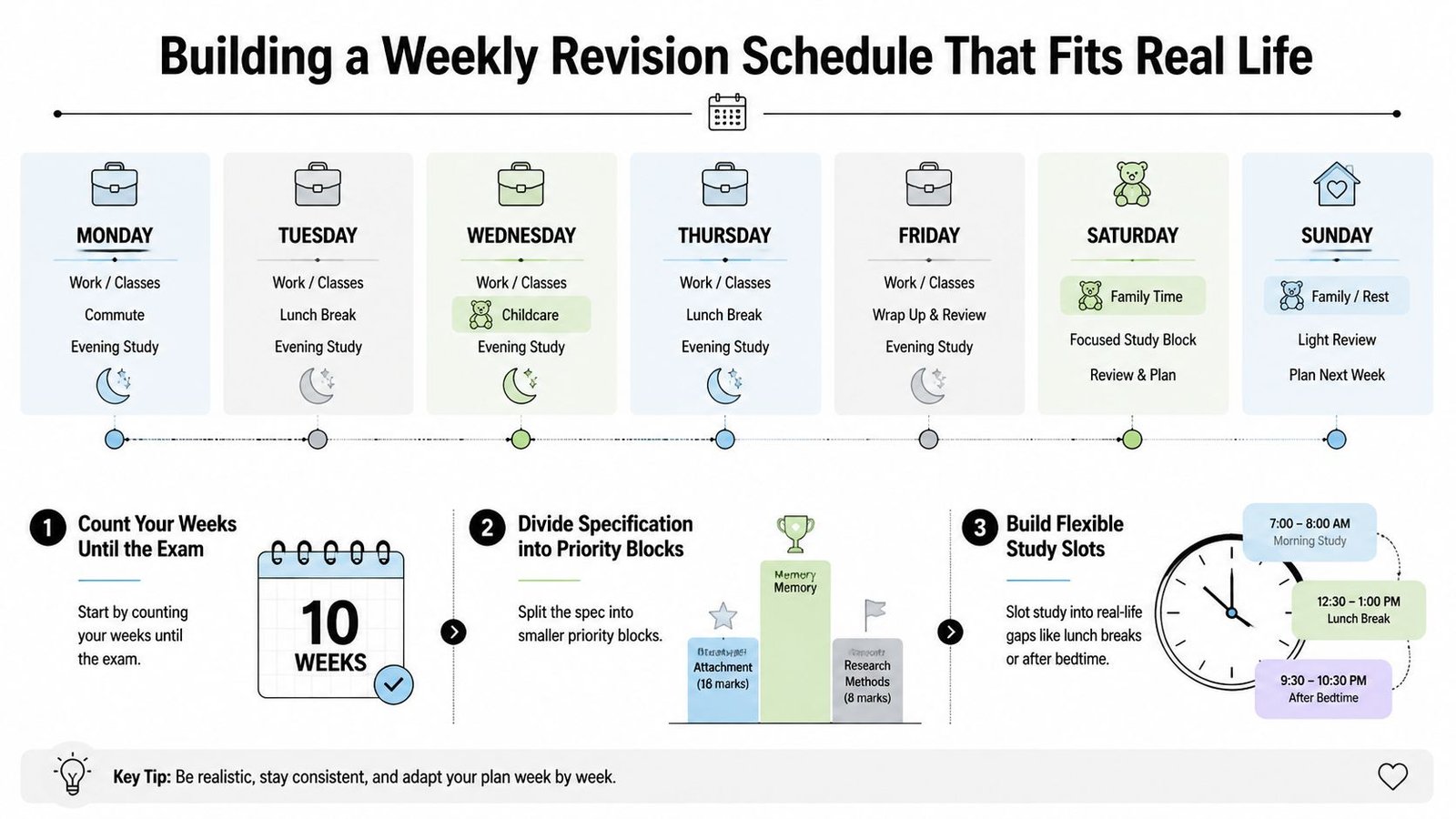
A revision plan should survive a late shift, an unwell child or an evening when you're exhausted. A timetable that looks impressive but collapses after a difficult week won't help you. A smaller plan that you can restart is far more useful.
Begin by counting the weeks until your exam. Divide your specification into priority blocks. Give early attention to broad understanding and research methods, then use later sessions for mixed questions, timed answers and specification checks. Keep two lists beside your timetable:
- Must revisit: Topics where recall or exam answers are weak.
- New or neglected: Topics you haven't studied properly yet.
Make a study evening predictable
A two-hour evening could follow this rhythm:
- First 10 minutes: Retrieve information without notes.
- Next 35 minutes: Learn one topic through a short explanation, diagram or video.
- Next 25 minutes: Answer exam questions.
- Next 20 minutes: Check the mark scheme and improve your answers.
- Next 30 minutes: Study a second topic or practise research methods.
- Final 5 minutes: Record what you remember and what needs another visit.
You don't have to use two hours every time. If life is crowded, use a 45-minute block and repeat it later. A helpful weekly rhythm includes one new-topic session, one retrieval session and one exam-question session. Study on the same days where possible, because a routine removes some of the daily decision-making.
Leave space for illness, work changes and family commitments. Review your plan each Sunday and move unfinished tasks rather than treating them as failures. Study planner templates can help you turn a large course into manageable appointments.
The best timetable isn't the busiest one. It's the one you can continue after a difficult week.
Active Recall and Spaced Repetition Made Simple
Reading notes can feel productive because the material looks familiar. Familiarity, however, doesn't always mean you can produce an accurate answer when the page is closed. Active recall fixes that problem by making you retrieve the information yourself.
Take obedience in Milgram's research. Read your notes briefly, close them and write everything you remember. Include the aim, procedure, findings, conclusion and one evaluation point if those details belong to your specification. Then compare your answer with the notes and mark the missing pieces. The correction is part of the learning, not proof that you've failed.
Three techniques for short study pockets
Spaced repetition means returning to the same material over growing intervals. You might review it the next day, three days later, one week later and two weeks later. Use a diary, calendar or flashcard app to schedule the reviews instead of relying on memory to remind you.
Interleaving means rotating topics rather than studying one area for a long period every time. In one 40-minute block, you might move between memory, attachment and perception. This feels harder than reading one familiar topic, but it encourages you to identify which concept a question is testing.
Active recall mirrors the exam. In the exam, your notes won't be open. Retrieval practice gives you repeated experience of producing definitions, study details and explanations from memory. Spacing helps you return before material disappears, while interleaving reduces the false confidence that can come from rereading the same page.
You can begin with one set of index cards, a diary and a folder divided by topic. Use a 20-minute pocket between work shifts, during a lunch break or after the household has settled. For extra guidance, use this practical explanation of how to use flashcards effectively.
This short video can also support your understanding of retrieval-based study:
Don't turn flashcards into tiny textbooks. Put one question on the front and a focused answer on the back.
Exam Technique and Question Walkthroughs
A strong psychology answer starts before you write. Read the question twice, underline the command word and identify the topic. Then check how many marks are available. A four-mark question needs a focused response, not a page of loosely connected facts.
Consider this specimen-style question:
Explain conformity in Asch's research. [4 marks]
The command word is explain, so the examiner needs more than a definition. You should show what conformity means and connect it to Asch's investigation. A useful plan might include the idea of changing behaviour or judgement because of group pressure, followed by a relevant description of the research and an explanation of majority influence.
Use PEE without forcing it
For a four- or six-mark response, PEE gives you a safe structure:
- Point: State the psychological idea directly.
- Evidence: Give a relevant study detail or example.
- Explain: Show how the evidence answers the question.
A response could begin: “Conformity is a change in behaviour or judgement caused by pressure from a group. In Asch's research, participants faced a majority giving an answer about line lengths. This demonstrates majority influence because the group's response could affect the individual's public answer.”
A stronger answer might use normative social influence if that term is relevant to the question and your specification. Precise terminology helps the examiner see that you understand the psychological process, but don't add specialist words to sound clever. Each term must do a job.
A question may test AO1, which involves knowledge and understanding, or AO2, which involves applying psychology to a situation. If the question gives you a source or scenario, use its details. Don't write a memorised paragraph that ignores the context.
| Command word | What it asks | Typical marks |
|---|---|---|
| Define | Give the meaning of a term | Varies by question |
| Describe | State relevant features or details | Varies by question |
| Explain | Give reasons and develop the point | Varies by question |
| Identify | Name the required item | Varies by question |
| Evaluate | Give strengths, limitations or a balanced judgement | Varies by question |
| Apply | Use psychology in the given situation | Varies by question |
Mark your own answer honestly
After writing, compare your response with the official mark scheme. Ask whether you included accurate knowledge, relevant evidence and a clear explanation. If the question is about evaluating a method, don't evaluate the study as a whole. If it asks about evaluating a study, don't spend the entire answer describing the method.
AQA provides past papers, mark schemes, examiner reports, Exampro questions and example student answers with examiner commentaries. Use them as feedback tools, not just tests. Rewrite a weak answer after marking it. The improved version teaches you more than seeing the score.
Free and Low-Cost Resources Worth Your Time
You don't need to buy every revision product you see. Start with resources that match your specification and give you a clear way to practise. The official AQA specification tells you what belongs in the course, while past papers and mark schemes show how questions are written and rewarded. Keep those documents in one folder so you don't lose time searching.
BBC Bitesize can provide short topic summaries and quizzes. Reputable YouTube channels may help you understand studies such as Loftus and Palmer, Bowlby's maternal deprivation and Sperling's sensory memory experiment. Use videos to clarify a difficult idea, then close the screen and retrieve the information yourself. Watching several explanations in a row can feel like revision without proving that you can answer a question.
Choose resources with care
Consider these affordable options:
- Second-hand guides: Look in charity shops or online marketplaces, but check the specification code and edition before buying.
- Libraries: Ask whether your library can make an inter-loan request for an AQA-approved textbook.
- Anki or Quizlet: Use free flashcard tools, but build cards around your own specification rather than downloading an enormous, unchecked deck.
- Official materials: Give priority to exam-board documents and mark schemes when an online explanation disagrees with them.
Free resources have limits. Online material varies in quality, old pages can confuse you and a large collection of links can become its own distraction. Track what you use for a week. Keep the tools that improve recall or answer quality, and remove the rest.
Know when support could help
A structured online course or one-to-one tutor may be useful when you're repeatedly stuck on one topic, practice answers remain below your target grade or you need accountability more than another set of notes. Paid support isn't automatically better, but a good tutor can identify the precise gap, explain it in plain language and give you a route back to independent practice.
Start free where you can. Spend money only when you can name the problem it will solve, such as unclear feedback, weak planning or uncertainty about your exam board.
Staying Motivated and Finishing Strong
Adult study can be tiring in ways that younger learners may not understand. You may cancel an evening because of work, fall behind after a family problem or feel guilty for studying when someone else needs you. A slow topic doesn't mean you're failing. It means your plan has met real life.
Motivation becomes more dependable when you connect it to visible action. Keep a specification checklist where you can see it. Each completed retrieval task, marked question and corrected answer gives you something concrete to notice. Don't wait to feel confident before studying. Let small completed commitments create confidence.
Create reasons to keep going
Use three simple supports:
- A progress tracker: Tick topics only when you can explain them and answer a related question.
- A weekly win: Mark one past question, review one card set or improve one paragraph, then acknowledge that work.
- A personal reason: Write why you started. It might be to reach university, move into a more fulfilling career, earn more, reskill or show your children that learning can begin again.
Your family may notice your effort even when they don't understand every topic. Children learn from seeing adults practise, make mistakes and return to difficult work. You become a role model not by pretending that study is easy, but by showing that responsibility and hope can exist together.
Remember: Your result will matter, but so will the example you set while working towards it.
Protect your wellbeing as part of revision. Sleep, movement, food and short breaks aren't rewards you must earn after studying. They help you return with enough attention to think clearly. If you miss a session, restart with the next available block instead of spending another evening criticising yourself.
Keep the final action specific. Open your notebook, write the date of your next exam and schedule your first 90-minute study block in your calendar before closing this page. That appointment is your starting point.
Next Level Online College offers flexible, fully supported GCSE courses for adults, with structured learning, subject guidance and wellbeing support designed around work and family responsibilities. If you want a clear route through psychology revision GCSE and recognised progression towards further study or university, visit Next Level Online College and explore the support available.